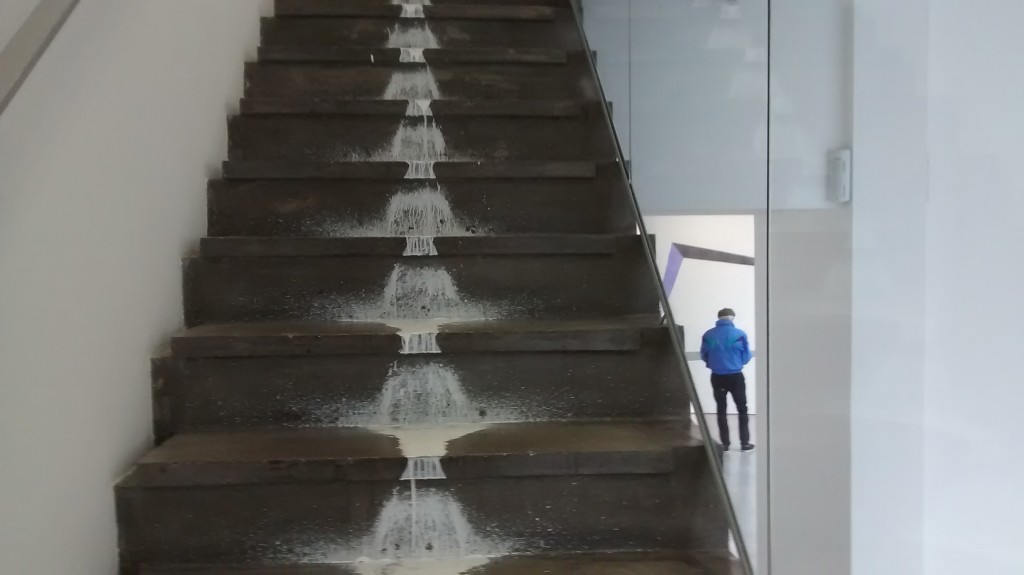
Walking into the Lisson Gallery, the woman standing around invigilating the ground floor spaces warns me to take care, as the walls are still wet. Or she says something like that. I’m not really paying attention and my hearing is no longer 20:20, or whatever the numbers are that audiologists use to measure those kinds of things, so I just sort of smile, nod and walk on. Anyway, I’m not going into her bit of the Gallery just yet as I like to go to the upstairs reception first, which is where they stack the leaflets explaining what the exhibition is about and also give out the little guide maps identifying which works are placed where.
As I make my ascent, it’s impossible not to notice the trail of white paint that’s cascaded down the middle of the stairs and I’m careful to place my feet either side of the obstacle. Of course, I’ve been to enough galleries and looked at enough art to know very well that what I’m being so careful to avoid treading on is not the result of some careless intern tipping over a tub of emulsion. This just has to be a bit of art, and when I get to the top of the stairs I can see that the trail leads right up to one of those paint machines that groundsmen used to wheel around, marking out the lines of football pitches, volley ball courts and the like. Final confirmation comes when I get the gallery guide, orientate the map and find that Ceal Floyer’s piece is titled Taking a Line for a Walk, a very literal representation of the famous Paul Klee instruction to his students as to how they might start making art. It’s the first work in a group show guest-curated by Drawing Room, a non-profit organization dedicated to promoting drawing which, judging by the show, is a term that they apply in the widest possible sense. In fact, of the fifteen artists whose work is on display, I don’t think there’s a single piece that could be called a drawing in the popular sense of the word. There are wall pieces, sculptures and video but nothing resembling a sketch and not a single work on paper and it’s almost as if the very purpose of the exhibition is to dare one to try to define what actually constitutes a drawing.
Julian Opie’s Pine Forest, consists of black vinyl strips stuck straight onto the wall and is the only piece of direct figuration although it’s been so stylised, silhouetted and cropped that it resembles a section of barcoding more than anything to do with trees or woods. Also in the upstairs space is a film of one of those marvellous performance pieces where the viewer is invited to watch an artist indulge in some meaningless exercise of sheer futility. This time it’s K Yolland’s and her endless struggle to lay flat a large roll of paper in the middle of the desert, while the billowing wind blows it about – and it’s strangely compelling. The fact that the specific space she is trying to delineate is the border between Mexico and the US adds a political resonance and perhaps offers an artistic rejoinder to the absurdity of the putative Great Wall of Trump.
Downstairs, Monika Grzymala’s impressive installation of interlocking swathes of masking tape sweeps over from one wall to another and onto the Gallery window like some enormous scribble come to life. While Athanasios Argianas’ Song Machine loops thin brass tape over a series of spindly armatures in a sort of visual representation of lilting musical rhythms – what might be called light metal, I suppose. Among the wall pieces is a familiar example of a Richard Long text poem, detailing the scenery on one of his long walks; and a single diagonal line, which must be one of the most minimal of minimalist drawings by Sol LeWitt. Slightly more substantial are the smears of fresh pink plaster on another wall and I’m wondering who the artist of this intriguing work can be when the penny drops and I can’t help blushing as I recall the comments of the invigilator when I first entered the Gallery. I almost repeat this appalling gaff when I find myself staring at some very slight scuff marks on another wall which, according to the map, should be something Untitled by Fred Sandback. This time I turn to the invigilator and she confirms that the work got moved and directs me round the corner where I finally locate an unassuming piece of yarn, strung between two adjacent walls. I think perhaps that my descriptions of these Minimal-Conceptualist artworks may be making them all sound a bit thin, literally and metaphorically, and that I’m not really doing them justice so it’s perhaps time to draw a line myself and move on – but not before saying that I liked the show a lot.
So, round the corner to Edgware tube and down to Piccadilly and a short walk round the back of the Royal Academy to Pace where an attractive selection of mobiles and other sculptures by Alexander Calder is interspersed by works from half a dozen winners of the biennial Calder Prize (which apparently awards funds to artists who are considered to be continuing the artist’s legacy). A couple of works stand out: Tomas Saraceno’s intricate web of wires that are attached to the walls of the gallery and come together to hold a central polyhedral enclave that could provide stylish accommodation for a rather sizeable spider. And the star of the show, Zilvinas Kempinas’ delicate circular ribbon of tape that twists and turns in the slipstream of air emanating from a large fan, and which proves a truly mesmerising spectacle, especially in conjunction with the background, chill-out bass noise from Darren Bader’s sound piece.
It’s another short walk to get to the David Zwirner gallery and a truly fascinating display of early paper collages from one of the superstars of American Pop Art movement, Tom Wesselmann. This terrifically interesting selection of small works shows the artist playing around with some of the themes that he would later develop into the large paintings that got him into all the Pop Art history books. For these works, Wesselmann first creates a series of drawings and paintings of anonymous nudes, in poses reminiscent of those used by European modernists like Bonnard, Rodin and Matisse. Then he places his models – whether reclining on sofas, sitting on chairs or taking baths – in highly decorated doll’s house rooms. And here he sets them to compete for our attention against the small cut out da Vinci or Rembrandt masterpieces stuck on the back walls and the highly coloured wallpaper and carpets set in the foreground. At some point it must have struck Wesselmann that instead of always looking back over his shoulder across the Atlantic and drawing on sources from giants among the art historical past, he might be better off bringing everything up-to-date and looking to the future that was all around him. And when he did this, relocating his models to downtown New York and placing them in modern household settings in contemporary pin-up poses, well, the rest, as they say, is Pop Art history.
Finally, across town to get to the Gagosian Gallery where someone has come up with the idea of gathering together a selection of portraits of celebrities from the ‘70s and ‘80s. Not a bad concept, except that they’ve chosen a half-and-half mixture of Richard Avedon black and white photographs and Andy Warhol coloured silkscreen prints. It’s like chalk and cheese, apples and pears, Cagney and Lacey or Eddie Murphy and Nick Nolte, so whereas Avedon seems genuinely interested in getting under the skin of his subjects and revealing bits of their personalities, Warhol is the exact opposite and, as we know, was only ever interested in the surface image. Putting the two together results in the total exhibition being a little less than the sum of the parts. It’s a lopsided match where the viewer is drawn to look deep into the photographic works in search of the soul of the individual sitters while a quick look at the gloss on the Warhol prints suggests there isn’t one there to find.