Get out at Embankment and take a walk along by the river, stopping for a look at Cleopatra’s Needle. Inscribed with hieroglyphs, guarded by a pair of bronze Victorian sphinxes and bombed by German aeroplanes during the First World War, this great big lump of stone must be the oldest, and certainly the heaviest, bit of public sculpture in the capital. It was a gift from the Egyptian government back in the 1819 and a very generous one at that, although, as part of the deal, we had to pick up the tab for postage and packing, which may have been a bit on the pricey side.
Anyway, this granite monument is just an amuse bouche, en route to Out There, the main course exhibition, organised by Historic England, that takes a look at some more recent examples of public art. Set in the East Wing Galleries of Somerset House, this fascinating little exhibition kicks off with a quick survey of the structures that ornamented the famous Festival of Britain that launched the Southbank back in the ‘50s. It then takes a tour round the country, stopping off at Harlow, Stevenage and various other post-war developments, to peer into their housing estates, shopping precincts and assorted public spaces, all of which were, more or less, grateful recipients of the state’s cultural largesse. The show includes a few actual sculptures of the period like Ralph Brown’s Meat Porters, where a pair of beefy men struggle to control a beefier carcass of meat, and Franta Belsky’s The Lesson where a mother helps a toddler take her first few toddling steps. But, for the most part, the show is made up of photographs, short films, architectural models and plans, artist’s maquettes and lots of typewritten documents. It’s a display that perfectly captures the feel of the time, when there was a sort of brash optimism among many artists, driven by the thought they might help create a braver, newer world, all mixed in with a nervous uncertainty as to how they might best achieve their aim. Neither of the figurative works mentioned above could be described as exactly joyful and some of the other, more abstracted pieces of art of the time, were decidedly gritty and gloomy, offering little aesthetic relief to the brutal, concrete architecture that always seemed to surround them and was so voguish at the time.
If many of the artists, and their works, were idealistic, worthy and perhaps a little bit dull, they can also seem uncertain of their Modernist credentials. By contrast, the establishment bureaucracy that commissioned them, was much more sure of its place in the world. There’s a strong sense here that everything is being directed by a powerful, patrician elite who haunt the corridors of power, and who have wearily decided that a bit of art might help civilise the New Town plebs. It’s exemplified by a photograph of an Arts Council board meeting, full of men in suits exuding confidence and authority. But if these are the grey men who commission the art, it’s the wider population who finally decide its fate. A wonderful TV newsreel shows Corbet Woodall, or some other BBC interviewer of the time with an equally snooty moniker – they often seemed to have peculiar names back in those days – interviewing a bunch of kids from Tower Hamlets. Needless to say, their reactions to some bit or art that’s been dumped, unannounced, into their community is greeted with a wonderful mix of giggles and raspberries. But, of course, the great thing about public art is that the public does actually get to express its opinions and, ultimately, determine the true value of the art. Sometimes an initial distrust slowly dissolves into a gradual, reluctant acceptance which, in turn, develops into a positive, familiar fondness. Alternatively, it’s graffiti and vandalism that seals the fate of the unwanted and unloved – and maybe that’s how it should be.
For the next course, it’s a short walk to the north end of Somerset House where the Courtauld Galleries are offering the latest in their imaginative season of temporary exhibitions, a selection of drawings by the great Renaissance master Sandro Botticelli. Originally bookbound illustrations to a volume of Dante’s Divine Comedy, these beautifully detailed works provide a marvelous chronological narrative of the poet’s famous sight-seeing journey through the circles of hell, the trials of purgatory and onto the uplands of heaven. Fortunately the Gallery offers magnifying glasses to enable the viewer to focus in on the incredible designs that Botticelli so lovingly traces, whether delineating the scary monsters and grim tortures of the dark side or the flowing veils, floating putti and city of light, at the preferred terminus to the tunnel of life. This sort of terrifically classy, comic book, story board makes for a delightful show that rewards those with the time and concentration to examine all the pages in depth but, be warned, it is all a bit faint and monochrome and, consequently, can be a bit tiring on the eyes. No matter, at the end of the show just take a saunter into the Courtauld’s permanent collection for instant visual refreshment courtesy of some of the Impressionist works – or give your optic nerves a real treat by sticking them in front of Manet’s Bar at the Folies-Bergere, the greatest work in the collection.
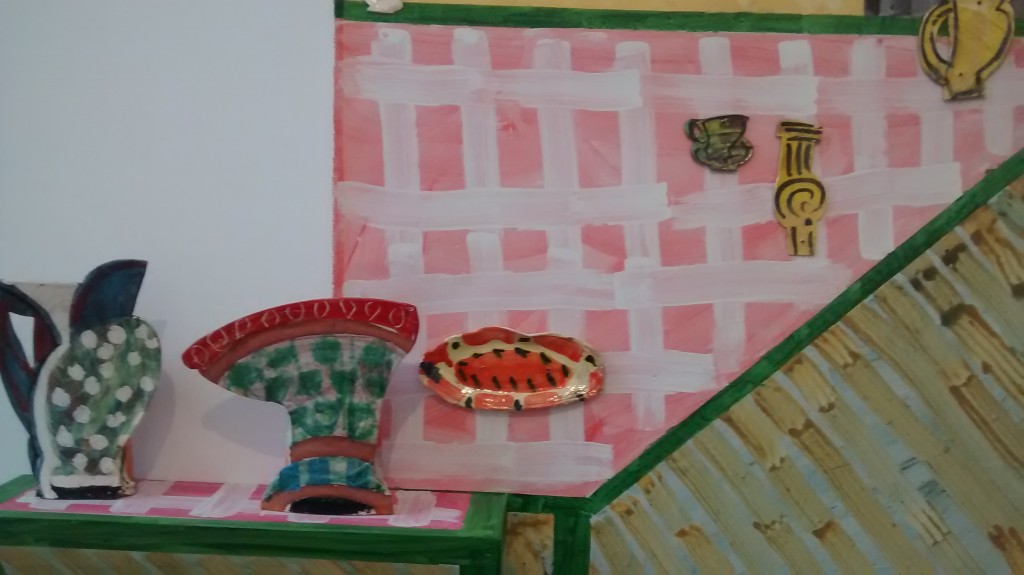
For a more tangible, not to say, digestible, pick-me-up I go out into the Strand and along to the Pret on the corner for a quick coffee and chocolate croissant. Despite the name, the pastry is formed into one of those straight designs so, doubtless, the European Parliamentary commissioners will, at some time in the future, force it to be retitled, unless Uncle Boris can lead the nation into a Brexit vote. Setting aside such tasty political topicality, I stride on past Trafalgar Square down the Mall and into the Institue of Contemporary Arts. Shows here tend to be self-consciously modish, by which I mean they tend to favour a seriously, studiously, stoically, puritanically, rigorous interpretation of Post-Modern tropes that may be cerebrally stimulating but can be a little visually boring. Not today! I can only imagine that the gallery director finally received a welcoming night visitation that put a smile on his face – that one of the ghosts of exhibitions past, present or future finally revealed something to him that made him loosen his intellectual corsets and allowed him to achieve a kind of existential relief. Wonderful. The result is a hugely joyful collection of exuberantly colourful tableaux from Betty Woodman that combine ceramics, fabrics and painted backgrounds, though I’m not sure what, if anything, these assemblages are meant to represent. There seem to be quite a few large water jugs sitting on ledges in a studio or lounge but whether they are symbolic, metaphoric, purely representational or something else entirely, I’m not sure it matters very much. Frankly, I’m just happy to enjoy the breath of fresh air that so rarely wafts through the galleries here.
For those tougher souls, disappointed at the thought that the ICA has gone soft, by staging something so light, bright and colourful, there is a smaller, darker display in the Fox Reading Room. This documents Art into Society, a show from the 1970s when a bunch of German artists, including Joseph Beuys, Hans Haacke and Gustav Metzger, were invited to strut their stuff at the ICA. Judging from the installation photographs on display, the exhibition was a mash-up of the kind of posters, political sloganeering, serious symposia and chalk board lecture note that made everyone at the time feel that they were in the forefront of changing the world, and that artists would be a force to be reckoned with, if only they could take themselves seriously enough.
Finally, dessert is over at the Barbican in the Concourse Gallery, the ground floor space that curves round like a French croissant, but might be more conducive to staging exhibitions were it to have the straighter sides of a Pret pastry. Because of the difficulty of hanging straight art on curved walls, the curators usually turn the space over to special site specific work and installations that try – and often fail – to make a positive feature out of the space’s awkward shape. Not today. Again the fearsome exhibition ghosts have been busy giving the curators a night time epiphany, for the current exhibition is a straightforward display of paintings, albeit the thirty or so works by Imran Qureshi are self-defined as miniatures. The jewel-like qualities are emphasised by each one being individually back-lit within a generally darkened gallery. Take a step back and the display looks terrific but lean forward and it’s a real shame to discover that all the works are so strikingly similar – minor variations on a theme of ferns and trees, some felled, some upstanding, but all repeated over and over and over again. Perhaps someone should escort Qureshi to the Courtauld and introduce him to Botticelli and show him what a real feast for the eyes tastes like.