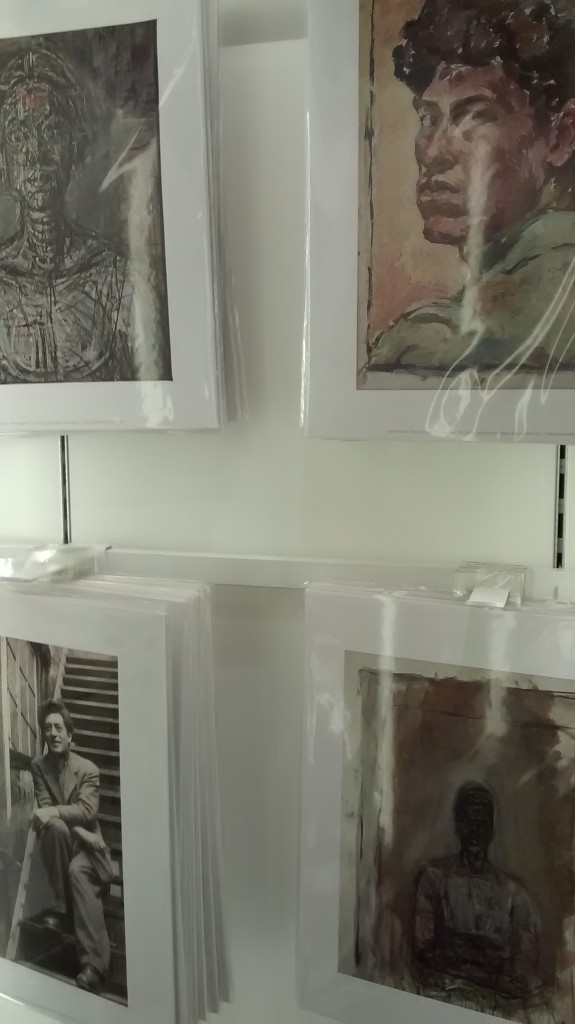
Take the short walk from Charing Cross tube station to the National Portrait Gallery for Pure Essence, an exhibition focusing on the portraits – sculptures, paintings and drawings – of Alberto Giacometti. The full price entry is £17, which is a bit steep, but with my National Art Fund card I get in for £6.75, which isn’t too bad. Thankfully, the rooms are spacious enough (and the numbers of visitors modest enough) for everyone to be able to wander around in peace and quiet, have a good look at everything and comfortably walk back and forth between the rooms. This is how exhibition-going used to be and how it should be and the very opposite of the bunfights familiar to anyone trying to see blockbusters at the Tate, British Museum or National Gallery.
Whenever Giacometti gets mentioned in any art books, his name is always linked to Existentialism and, finally, here I discover the reason why. It seems that the great Jean Paul Sartre himself wrote catalogue notes for Giacometti’s first one-person exhibition in New York in 1948, suggesting that the work was, ‘always mediating between nothingness and being.’ It sounds a bit like the title of a book, although quite what the gnome-like Sartre meant by that gnomic phase is not all that clear to me. And, even though I’ve read Roads to Freedom a couple of times, frankly I’d be hard pressed to give a convincing definition of exactly what Existentialist philosophy was all about. As for its application to, or relationship with, art, I haven’t a clue – not that this has ever held me back from dropping the word into polite conversations. And since no-one’s ever challenged me when I’ve done this, I suppose, perhaps unwittingly, I do actually know what I’m talking about. More likely, nobody else does and they’re happy just to go along nodding at what I say, rather than risk calling my bluff.
Anyway, regardless of the finer points of knowing what any of us are talking about, the one thing we can all surely agree on is that the nouns most commonly associated with the Existential adjective are not joi de vivre, bon viveur, esprit de corps or even potatoes dauphinoise but…angst. And you don’t even have to know what Existential angst means to intuit a sneaking suspicion that the works of Giacometti probably have it by the bucket load.
But let’s start at the beginning. It seems that Giacometti’s father was an artist and, judging by the one drawing of his on display here, he seems to have been really quite skilful. Apparently he painted in a colourful, Post-Impressionist style and his son, the young Alberto, briefly followed suit. There are a couple of examples of this very early work which are certainly competent and have something of the palette of Gaugin but without quite his skill in its application. Anyway, enjoy the colours here, for they’re absent for most of the rest of the exhibition or, rather, they exist within the confines of a very small, muddy spectrum that ranges from ochre through beige and, not unexpectedly, ends in black. But it’s not just colour that Giacometti abjures, the painterly style that became his signature trademark is totally without tone or shade, and comprises just a rough background wash covered with a concentration of scratchy lines.
Some artists enter the studio every day looking forward to having an enjoyable time splashing around with paint like the cliched child in a sweetshop – others are compelled to produce art, knowing each attempt will be an intense struggle that only rarely results in success. Judging by the intensity of Giacometti’s marks – whether the criss-cross exoskeleton web of lines that go to making up one of his paintings or the sculpted busts, made from tormented bits of clay that have been repeatedly squished, stretched and pinched into submission, before being cast into bronze – he clearly falls into the latter category.
Was all the suffering worth it? Well, in the course of Giacometti’s fight to find a satisfactory way of reproducing what he saw in front of him, he did manage to discover some original and still strangely fascinating sculptural templates. Chief among these slightly Surreal techniques was the trick of producing a bust where the head of the sitter is of an absurdly reduced scale with reference to the torso, or where the head has been flattened into a plane, perpendicular to the viewer. Are the portraits any more accurate or meaningful for having been so distorted? I don’t really think so but neither do they look as silly as one might expect from the simple description that I’ve just given.
It’s a pity that the exhibition doesn’t show more of Giacometti’s other defining work: the tall spindly characters with the massive feet, or the tiny matchbox-sized figures. But presumably, these being representations of the Existential Everyman, rather than specific portraits of friends, relatives, models or acquaintances, were rendered ultra vires for this portrait show. It would also have been good to see again the haunting Woman with the Throat Cut, Giacometti’s most famous Abstract Surrealist work, but the victim was unnamed, her anonymity again denying her a place in this exhibition. I suppose what I’m saying is that I would have preferred to see the full-blown retrospective that the artist so obviously warrants. In the meantime, this show can be definitely recommended, although it does carry a health warning in that you may find yourself exiting the Gallery with an Existential cloud hovering above your head. If so, the best cure is a cup of tea and a good giggle, both of which can be had courtesy of the Gallery’s subterranean café. Here the food is ripe with such a peculiarly prissy, twee, self-conscious pretentiousness that the menu, brimming as it does with butternut squash fol-de-rols, scotch egg and black pudding doo-dads and mushroom with truffle oil twiddle-twaddles, is guaranteed to raise a smile in all but the most hardened hipsters and foodies.
I’m still chuckling to myself over the comestible absurdities as I window shop my way along the bookshops of Charing Cross Road, pausing only to admire the Surreal – or is it Post-Modern – addition to the famous Centre Point building. It is as if the great Christo himself has paid a visit and made one of his characteristic artistic statements. The skyscraper has been given an enormous protective jacket, its glass and concrete façade now hidden by a cartoon-like replica, printed directly onto the massive prophylactic.
I carry on down Charlotte Street and turn off to get to the Rebecca Hossack Gallery and, just as I’ve started looking around, in strides my old friend and former employer, the eponymous Ozzie entrepreneur. It’s lucky to catch Rebecca these days in her Gallery as she’s almost always out, touring the world, showing work at an art fair in some exotic location. Either that or she’s roaming the outback for the latest Aboriginal originals, or emulating her hero, Indiana Jones, and venturing deep in the heart of darkness on the trail of some lost tribe of artists.
As always before I get to hear of her latest adventures in Miami, Venice, Timbuktu or Kathmandu, she insists on continuing to attempt the sartorial makeover first started when I was her bookkeeper back in the ‘80s. In those days it was my Frank Zappa goatee that had to go, along with my cascading ringlets, Levi jeans and Doc Marten boots, replaced by a neatly tonsured coiffeur, tweed jacket and assorted fake designer boots and strides. I’m not sure I ever did look the fashionable Eliza Doolittle dude that my antipodean Henry Higgins sought so determinedly to construct and the transformation certainly didn’t last long after I left Rebecca’s employ. But she’s not one to give up on a project and this time it’s the plastic bag in which I carry my newspaper and other important documents that comes in for a brutal critique. I thought the bottle green colour was rather fetching and the gilt lettering, announcing that I am a customer of Peter Harrington Antiquarian Bookshop – especially since it includes their Mayfair address – would correctly identify me as someone familiar with the boutiques and purlieus of the better parts of the city – in short, a man of taste and refinement. Apparently not, plastic is passe and so she disappears into the backroom and returns to give me a replacement bag – something organic and textile, complete with her Gallery name and logo. I try to explain that now I’m writing my artworld blog I must appear impartial, and carrying around a bag advertising her Gallery would compromise my integrity. The argument is given short shrift and she reminds me that it was her idea in the first place that I should start writing a blog – and she may be right. Anyway, she’s a forceful woman, and there’s no point arguing, so I put it on my shoulder and feel decidedly uncomfortable (but at least I can take it off when I get out the Gallery and it will mean one less Christmas present to buy).
As for the art, well, there’s a bunch of colourful Aboriginal dot painting on the top floor of the Gallery and Laura Jordan’s clever, witty cartoon and collage Cityscapes on the first floor. The highlight of the mixed exhibition on the ground floor is Edgardo Rodriguez’s wonderful bright and breezy sculptures of Mexican cacti and French snails, constructed from recycled plastic fizzy drink bottles. I think Rebecca said they were only £80 each which, if I heard her correctly, seems a real bargain price.
I promise Rebecca that I’ll give the Gallery a plug in the blog, in exchange for which I get an invite to her Gallery’s Christmas party in a couple of weeks’ time. Already I can see that I’m in danger of succumbing to temptation and compromising my blog impartiality. Oh well, at least it’s in a good cause.
And good news, Virgin Trains have given me a voucher for £45 to compensate for the hour’s delay suffered on my recent trip to Manchester..