Get out at Holborn and weave my way through the backstreets to within spitting distance of the mighty British Museum but expectorations will have to wait as I’m not going there today and instead turn off to enter the Enitharmon Editions shop. Inside is a wonderful collection of odd little prints and, more particularly, copies of the special edition books that they so lovingly commission and publish. It’s a great place to rummage around in if you want to pick up something by artists like Jim Dine, Paula Rego, Tony Bevan or Shanti Panchal or get their latest edition of Under Milk Wood specially illustrated by Peter Blake – the de luxe version coming complete with limited edition print. The bulk of the books they publish are works of poetry but since my knowledge of that literary form is limited to a couple of verses of Larkin, a bit of Ogden Nash and a handful of ribald limericks, I’ve no idea whether their stock is any good or not, although I’m pretty sure it would be.
A couple of doors along is the London Review of Books bookshop and café and peering in through the window – well, I failed the entrance exam so I’m not allowed in – I can just about make out Isaiah Berlin arm wrestling Will Self (who knocked out Salman Rushdie inthe quarter finals) and, is it a trick of the light or is that, Vladimir Nabokov in a booth at the back, sharing a joke with Melvyn Bragg?
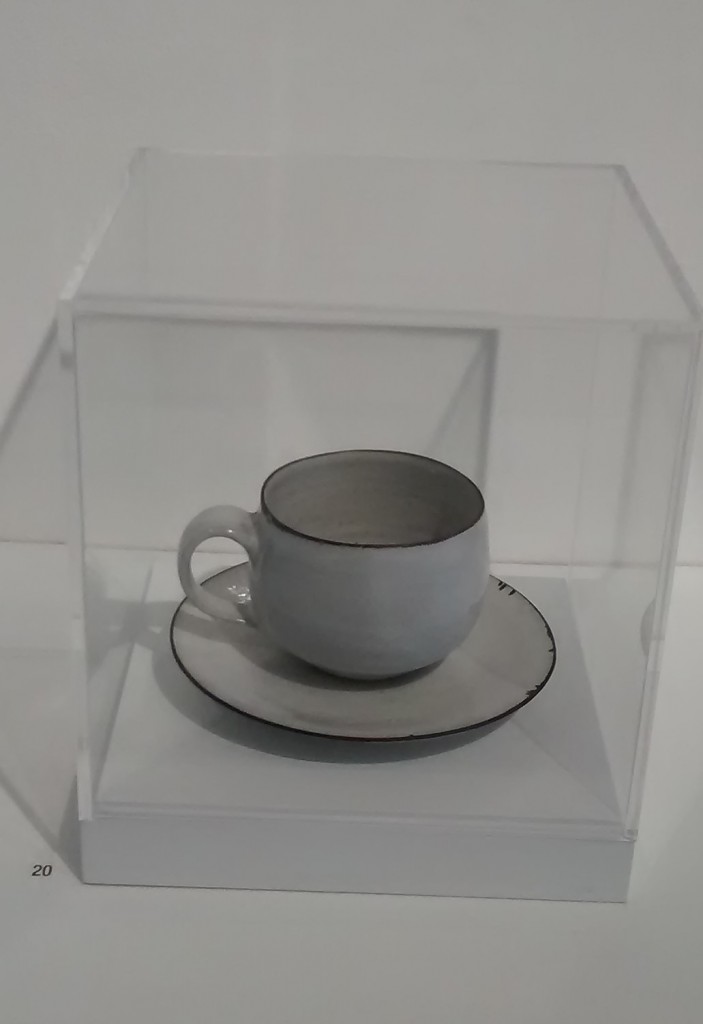
I head round the corner to Austin Desmond Fine Art and their current show Aspects of Modern British Art which, to paraphrase that esteemed critic Forrest Gump is a bit like a box of Quality Street with, fortunately, more coffee creams than gritty pralines. In fact, some of the stuff here makes one proud to be a Pom. The Edward Burra watercolour, the Ivon Hitchens print, paintings by John Hoyland and Victor Pasmore, drawings by Roger Hilton and Colin Self are all pretty good, even if they may be a bit parochial. But what’s wrong with that? The standout item for me, however, is Lucie Rie’s very simple, very beautiful ceramic cup and saucer, which could be yours, or even mine, for just £1,000. And who wouldn’t want their afternoon cuppa to be served in this? Although, by the same token, who, having supped, would have the nerve to stick it in the dishwasher and press the button? I get into a discussion about this conundrum with the charming woman who’s keeping shop. How should one treat this beautiful object? Should it remain forever sheltered in its glass case or should it be used for the purpose for which it was originally created? Perhaps the answer is to buy it as a gift for someone and give it to them without revealing its cost, for fear of inhibiting them from using it. On the other hand, what’s the point of giving someone a really expensive gift if you can’t let them know how generous you’ve been? In the end, my final suggestion is that one should buy the cup, down one drink and then throw it into the fireplace. I think that’s probably the best way to release the elan vital.
As soon as I have a spare grand then that’s what I’m going to do, in the meantime I head east and cut back across Southampton Street to get to the October Gallery for a comprehensive display of paintings by Gerald Wilde, not a very familiar name but perhaps one who should be. Most of the work seems to come from the immediate post-war period when, like many of his contemporaries, he set about trying to find an appropriate painterly language for the new, modern world. What we get are variations on figurative themes painted with thick black lines reminiscent of Rouault. Evidently he found this form no longer sufficient to convey the post-Holocaust, post-Hiroshima world and so, along with transatlantic counterparts like Pollock and Rothko, experimented with using a sort of Surrealist automatism to overlap the figurative elements and came up with new forms that satisfactorily squared the abstract circles that he was working with. If not quite as fresh and radical as the different Americans solutions that gave rise to a whole industry of Abstractionism, they retain a definite sense of power and accomplishment.
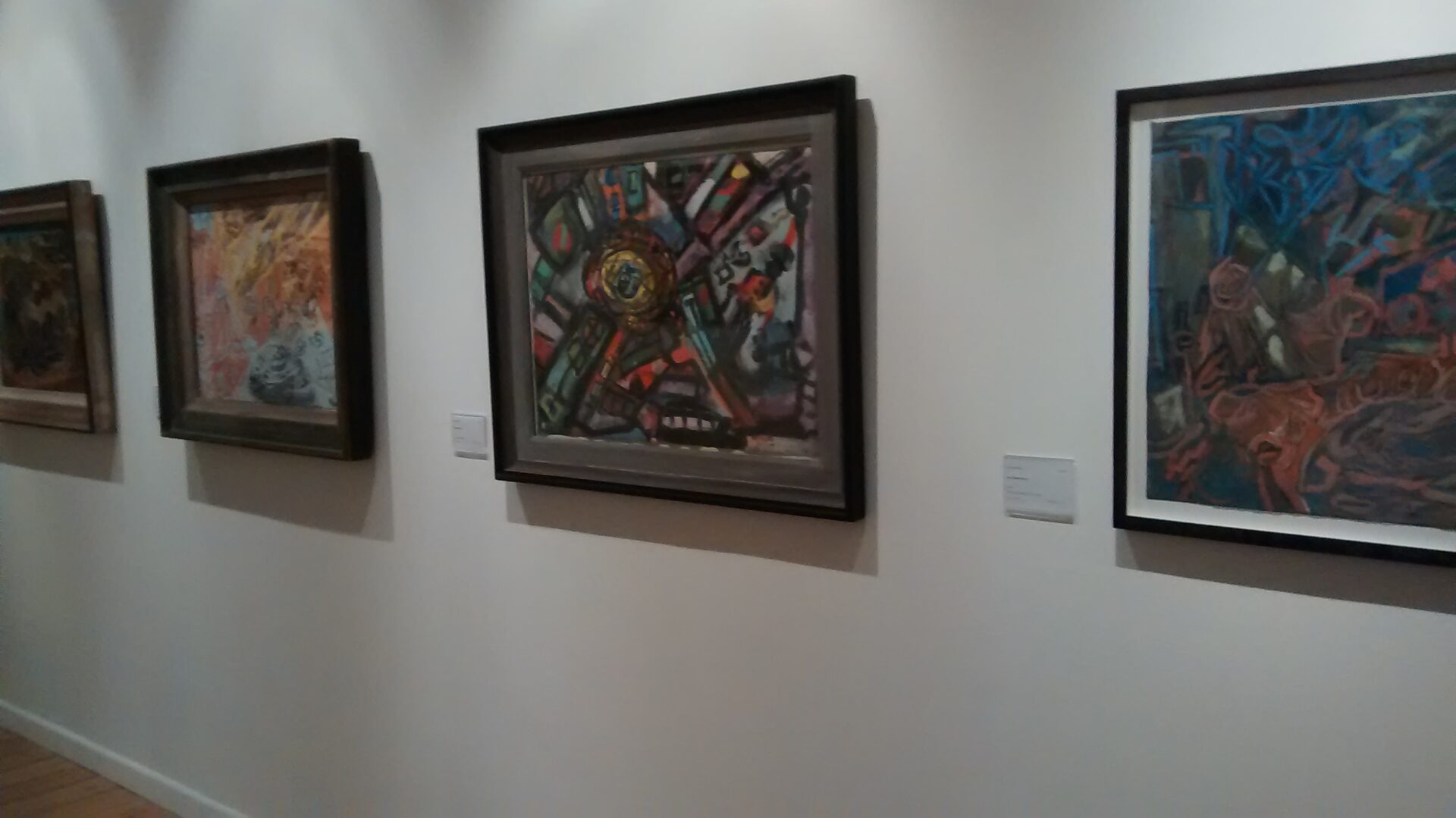
Although Wilde achieved some level of success and recognition in the 1950s, due to unexplained personal problems, he seems to have stopped painting in the ‘60s, which inevitably must have hindered his career development. But apparently he regained his mojo in the next decade and then continued making art until his death in 1986.
To coincide with the exhibition, the Gallery is showing Alec Guinness’ film The Horse’s Mouth, which is based on Joyce Cary’s book of the same name. Both book and film are essential classics for anyone with an interest in British art, especially from that austere period during the 1940s and’50s. And although the Gallery specifically states that Wilde (though known to Cary) was not the inspiration for the lead character, the penurious, wily, itinerant artist Gulley Jimson, the suggestion remains that perhaps they may have shared some similar traits. Anyone who has ever come into close contact with any professional artists may also recognise the sheer, bloodyminded, self-centered determination to go to any lengths, however unrealistic, demanding or absurd, to carry on producing their art. And while this attitude is probably essential for artists to convince themselves of the validity of what they’re doing, and so carry on when all about are slagging them off or, even worse, just ignoring them, this can become a bit of a strain for everyone else around them. But then I suppose this is just the price that society has to pay for its culture and occasionally it may turn out to be worth it.
I get the bus and go north into the wilderness of the Caledonian Road until reaching the oasis that is the Large Glass gallery. The name is deliberately Duchampian and Charlotte, the proprietress, can be relied upon to stage shows of an appropriately cerebral nature in honour of the great Dadaist. This time it’s a display of large black and white photographs by Craigie Horsfield, although the phrase black and white scarcely does justice to the range of gray gradation between these two spectral ends. Each scene has been lit with such precision and perfection that, even without my varifocals, everything falls into beautiful, perfect focus. And what is the subject of all this loving exposure? Workers reveals portraits of carpenters, lathe turners and other production workers at a Polish factory going about their daily duties. Horsfield’s talent is to transform these scenes of mundane endeavour into jewel-like studies in silver and jet and he succeeds admirably. Of course, the argument against this extreme Formalist approach to photography is that it risks dehumanising the people in the pictures and reducing them to mere ornaments. It’s true that Horsfield tells us nothing of the interior lives of the workers and, frankly, when we can see their faces they don’t look exactly joyful although I suppose if they did we would be completely distrustful of the picture.
Looking at the photographs leads me to reminisce with Charlotte about my own melancholic experiences of factory life, when I had to dress up in ill-fitting overalls and clock in for my shift of stacking crates. I can’t help wondering had Horsfield had come to my bottling factory whether he’d have been able to immortalise me into a work of art?