A couple of years ago, when I was trying to sketch out some draft chapters on a historical guide to Modern Art, I spent quite a lot of time thinking about when and where would be the best place to start the story. In the end, I decided to take quite a long run up and begin way back at the end of the 18th century with the country’s all-time favourite artist: the prodigious and prolific Joseph Mallord William Turner. Then it was a quick shuffle via that very specifically British institution, the Pre-Raphaelite Brotherhood, before getting down to the famous French Impressionists when the world really did start to become noticeably Modern and the art began to follow a parallel course. Had I been writing my art history stuck in a garret in Paris, rather than a tiny flat in Chiswick, then, for the sake of cultural chauvinism and patriotic pride, I would almost certainly have picked a different symbolic figurehead. But, if not Turner then who would be the most suitable French candidate to occupy the equivalent honorary position? Well, how about his near contemporary, an artist who holds a similar iconic status in his native country, another so-called Romantic, the almost (but not quite) equally prodigious and prolific, Ferdinand Victor Eugene Delacroix?
Whether either of them can really lay claim to being the godfather of Modernism is hugely debatable but then if such a debate could provide a bit of harmless intellectual diversion and so keep some of those gangs of rowdy, rough-neck, art historian academics off the streets at night well, I suppose, we should probably lend it our support. Of course, being just a humble, amateur art hack, I’m not really qualified to join in the discussion but since when did a lack of factual knowledge, in-depth personal research experience or hard-won wisdom ever hinder anyone ever joining in this kind of pointless, navel-gazing argument. And I feel fairly certain that I can match my professional peers in pretentiousness, wild theorising and assorted rhetorical sleights of hand. So, for what it’s worth, I think that both Turner and Delacroix achieved their success by being such strong individualists that, almost by definition, this prevented anyone else from following directly in their footsteps and carrying forward, or otherwise propagating, their specific painterly legacy. If they did have any influence on those that came after them, it was perhaps more by way of providing a template for the modern artistic temperament, where the rebel outsider achieves his rightful position through a mixture of strong self-belief and dogged determination, having battled against an establishment that alternately reveres and reviles. As for trying to come up with a more direct, painterly path to Modernism from either of these artists, that strikes me as all a bit fanciful. Turner’s loose, expressionistic brushwork was utterly rejected by the Pre-Raphaelites who followed him – in the chronological rather than stylistic sense – since they favoured an almost neurotic attention to precision painterly detail and eidetic accuracy. And similarly, while Delacroix was the master at capturing the vivid, violent excitement of specific heroic scenes of dramatic derring-do, the Impressionists were all much more concerned with perfecting the technical tricks required to recreate the constantly changing effects of light and atmosphere. And rather than trying to select deliberately flamboyant stories from history or literature to illustrate, they accepted that the everyday world around them was interesting enough to provide the subject matter for them to try out their innovative stylistic techniques.
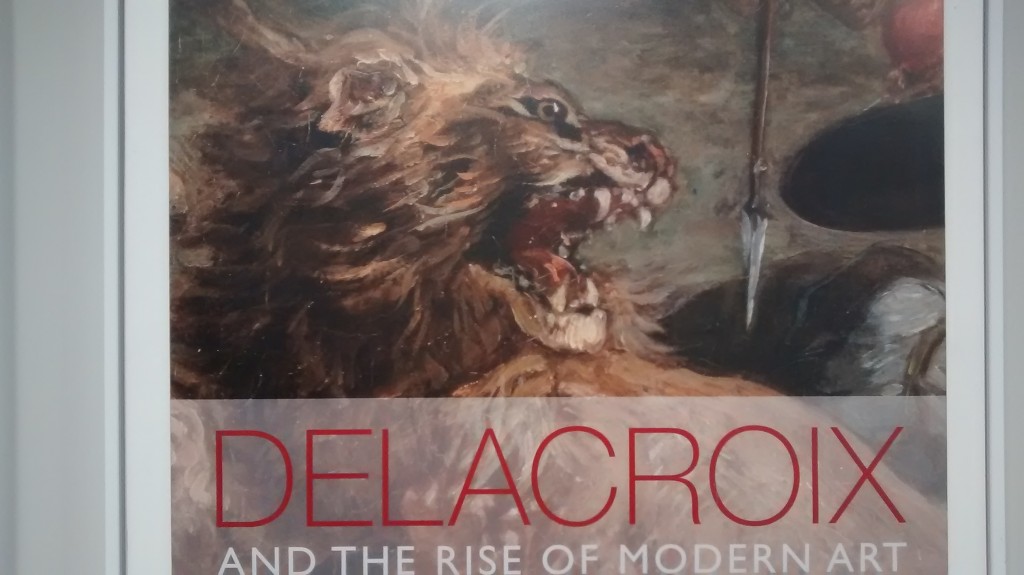
Anyway, enough of my rambling thoughts on the development of art history and over to the experts from the Minneapolis Institute of Art and our very own National Gallery, which is currently the venue for their joint enterprise, a rather curious, but nevertheless interesting, exhibition entitled Delacroix and the Rise of Modern Art. There’s no hint of a question mark in the title so I think it probably fair to say that, despite any of the little historical spanners and caveats that I’ve tried to insert a few paragraphs back, the big boys are quite decided in their case that Delacroix was indeed the essential precursor to the modern age of art. In an attempt to prove their point and convince the rest of us, they have now filled the Sainsbury Wing with a few dozen Delacroix paintings and a matching number of works by his contemporaries and some of the other big names of French art that succeeded him. So, how well do the academics fare with promoting their proposition? Perhaps they manage to make their case in the catalogue essays with greater levels of literary subtlety and sophistication than they do with the exhibition of paintings, since these could hardly be presented in a more plodding and unimaginative manner. Basically, what the professors have done is to find a subject painted by Delacroix and then rifle through the store rooms to find the same subject as painted at a later date by someone now recognised to be a fully paid up member of the modern artist’s club. Said works of art are then displayed side-by-side and, presumably with a shout of QED echoing round the galleries, the curators have patted themselves on the back and declared: mission accomplished.
So, for example, we have Delacroix’s full-length portrait of the suave Louis-Auguste Schwiter, complete with white gloves, cravat and frockcoat is matched by the full length portrait of Lord Ribblesdale in top hat, breeches and riding boots by Singer Sargent. Delacroix’s slightly absurd Death of Sardanapalus, in which the great king casually lounges in his bed whilst all around is a mayhem of wailing concubines and screaming eunuchs, is placed next to Cezanne’s equally perverse Eternal Female, in which the faceless femme fatale is surrounded by an even more bizarre crowd, including a bishop, an artist at his easel and a pair of trombone players. And then we have Delacroix’s sketch for Apollo Slaying a Python accompanied by an equally sketchy Pegasus and the Hydra by Redon. All of this is just in the first room but I could go on…and on, as the uncomfortable pairings continue throughout the whole show. While, of course, it’s always pleasing to see unfamiliar works by Fantin-Latour, Courbet, Renoir, Degas, Van Gogh and others, the links between their works and those of Delacroix seem to me to be seldom more than superficial. Some work a little better than others but none is entirely convincing since Delacroix, following his Romantic instincts, tends to throw all he’s got at whatever he’s painting, happy to tart up the colour scheme or adjust the anatomy of any man or beast he can drag into the fray if it will enhance the overall dramatic effect. It’s true that these kinds of exaggerations do appear in Modern Art but only once the Impressionists, the true forerunners of Modernism and the descriptors of the modern age, have come and gone. And then, when this kind of distortion does appear, in the Post-Impressionism of Gaugin, the Fauvism of Matisse or the Expressionism of assorted German groups, the colours are much more willfully exotic than anything Delacroix ever dared to dream of, while the subject matter becomes less fanciful and frequently more mundane. There may be plenty of bright orange trees, pink horses and jagged, unnaturally spiky prostitutes in Modern Art but I think I’m pretty safe in saying that, there are no examples of lion hunts in the entire modern canon post-Delacroix. If one truly wanted to plot an accurate course to show how the art of excess progressed from the Baroque extravagance of Rubens through the radical designs of Delacroix, then I would propose that the true inheritors of the mantle of manic art production are different kinds of artists with their works not to be found on the walls of art galleries but on the screen of cinemas, courtesy of directors like Sam Peckinpah, Ken Russell and perhaps, more recently, Quentin Tarantino.
Having said all that, even if the central argument that Delacroix was herald to the rise of Modern Art holds a similar amount of water as the idea once promoted that Turner begat not just Impressionism but also American Abstract Expressionism, there is a great deal of fascinating and first class art to be seen in this show. And fortunately, since Delacroix doesn’t have the same name recognition pulling power of Goya or some of the other stars that have recently filled the rooms here, the crowds are absent (at least they were when I went along) and it’s possible to see all paintings without too much of a struggle. If it had been left up to me then I’d have displayed all the Delacroix paintings in a straightforward chronological succession since, for those of us not overly familiar with his work, it would have helped to see how his style evolved and whether he got more or less manic as his career progressed. Then, after telling his story, I’d have simply stuck all the rest of the stuff in a bunch at the end. But such a radically straightforward suggestion doubtless helps to explain why I continue to have to style myself as, yours faithfully, Arthur, rather than Professor, Berman.