
Go down to take a look at the ruins of Cork Street. Well, it’s not quite that bad but the place is still looking in a bit of a sad and crumpled state, half way through its major face-lift operation. Hopefully, when the bandages come off, the building work has been completed and the dust finally settles, it will return to something like its former glory and a string of small commercial galleries will fill up the spaces underneath the new slinky offices or flashy flats or whatever it is that’s now being constructed there at such great expense and disruption. Ever since I first plucked up the courage, all those many years ago, to risk entering a private art gallery just to look at the art – no chance that I could ever afford even to dream about actually buying any of it back then – I’ve been wandering down Cork Street. Back in those days it was definitely the place to go to see what was stirring in the Modern Art jungle and I gradually became inured to the condescending looks from the pretty, posh receptionist creatures who sat behind their desks staring at my tattered student apparel as carefully as I studied the art on the walls. Over the years many more galleries have joined the London art scene, creating their own little hubs in Hoxton and various other unfamiliar locations, and Cork Street has inevitably lost some of its power and status but even now it’s still usually worth a visit. And as I get older, I find that the receptionists seem to get younger and less intimidating, or maybe my sartorial standards have risen and consequently attract less attention. Then again, maybe as I’ve got older, deafer and more short-sighted, my skin has thickened and I no longer notice the stares, whether patronising or pitying. Still, there are, of course, some constants: the Cork Street art retains its high standards, at least in some of the galleries, and most of it is still way beyond my financial grasp although, some years ago, I did buy a Peter Blake print of James Joyce from today’s first port of call, the Alan Cristea Gallery.
The work on show today is far less familiar stuff, at least it is to me. Paul Winstanley’s photographs are a selection of shots from his slightly obsessive, slightly bizarre mission to document the interior of every art school in the country. But the aim of this task is not to produce a catalogue detailing the architectural differences of the buildings or, indeed, to relate anything much about the places at all. Winstanley’s very deliberately taken discrete shots of the temporary studio spaces that the students use to display their works but only after both students and works have departed. The whole enterprise is, in fact, just a pretext for the photographer to produce a string of shots of wall panels flecked with paint but otherwise totally devoid of any characteristic specific to their location. The result is a series of near-abstract images that resemble at first glance the sort of cool arrangement of shapes and colours that lie on the spectrum somewhere between Mondrian and Barnet Newman or one of the other hard edged post painterly American Abstract Expressionists. If they’re all a bit too cool and contrived then a couple of doors along, in the other Cristea space, there are some more welcoming, warmer hues inspired by an altogether more pleasant environment. The prints here by Joe Tilson are large and colourful, bright and breezy and appear to be the result of much happy meditation wandering around the piazzas and canals of Venice. All follow the same general pattern whereby the central motif of a façade of a church or palazzo is roughly sketched out and surrounded by a great joyous fanfare of mosaic patterns. While it doesn’t accurately convey the cool and soggy meteorological conditions of my last visit to the Italian wonderland, it perfectly captures the light and vigour of how the place is meant to be, and probably how it remains in most people’s dreams.

Hurrying quickly past all the men in their hard hats and hi-viz jackets who are playing with their real life Tonka Toys I get to the other end of the street and enter the Flowers gallery. But it’s only a short visit. The abstracts on show here by Terry Setch are just not my cup of tea. It’s not so much that he flings a pots of paint at his grungy canvases but rather covers them all in a curious gloop of sludge that puts me in mind of the slime that drips from the sci-fi monster in one of Ridley Scott’s Alien films. Across the road at Waddington’s is, for me at least, a much more attractive display in the form of a sort of mini-retrospective collection of works by Barry Flanagan. There are a few simple torn paper collages and photographs but the bulk of the work are his sculptures – or maybe they should be called anti-sculptures – from the 1960s and ‘70s. Back in those days, when students were revolting, the arty ones decided to express their rebellious nature by being deliberately disrespectful to their tutors and predecessors. And if you fancied yourself as a sculptor then the best way to do this was to stick two fingers up at the heavyweights of the previous generations as personified by Henry Moore and Anthony Caro and exemplified by their macho exertions, whether carving great trunks of wood, chiseling chunks of marble or welding together cast iron girders. For Flanagan and some of his contemporaries the trick was to insist that solid 3-D work could be made from non-traditional materials, the more unlikely the better. And while the works on display here no longer carry the same shock value they had when first displayed, nevertheless, the pile of blankets, the ton of sand swept into a corner, the layers of fabric hung on the wall all still look rather lovely.

Across the road at the bottom of Cork Street is the Pace London gallery which is currently showing work by Wang Guangle who, apparently, is one of the ‘preeminent abstract painters of his generation in Beijing’. The works on show here fall into two categories – either the rainbow of colours flattened into thin horizontal strips or else the big splodges of pale, monochrome yellows and beiges. The former are pleasant if unexceptional and the other are all a bit dull.
Finally, I take a Jubilee tube ride from Green Park to London Bridge to get to the Eames Gallery which is currently displaying a near complete folio set of prints from Goya’s famous Los Caprichos series. The opening image is a self-portrait of the artist looking rather haughty in his top hat and cravat but all the rest of the works are tableaux in which a cast of stock characters – the spoilt child, the wily woman, the innocent maiden, the deceitful man, the superstitious old crone, the ignorant professionals – illustrate various moral fables for our entertainment and instruction. Some of these are fairly straightforward – spare the rod and spoil the child; beware of following stupid superstitions; don’t eat cheese last thing at night – while quite a few seem to have lost something in both translation and transition across the couple of centuries since their creation. But even when it’s hard to figure out exactly what is meant to be going on and why the man is carrying his donkey and who are the little sprites that the maids are beating with their brooms, the images look surprisingly sharp and fresh with their clean lines and quirky content. As if to confirm the point, the Gallery has also put up some contemporary prints by Paula Rego and Ana Marie Pacheco that appear very much influenced by the great Spanish maestro.
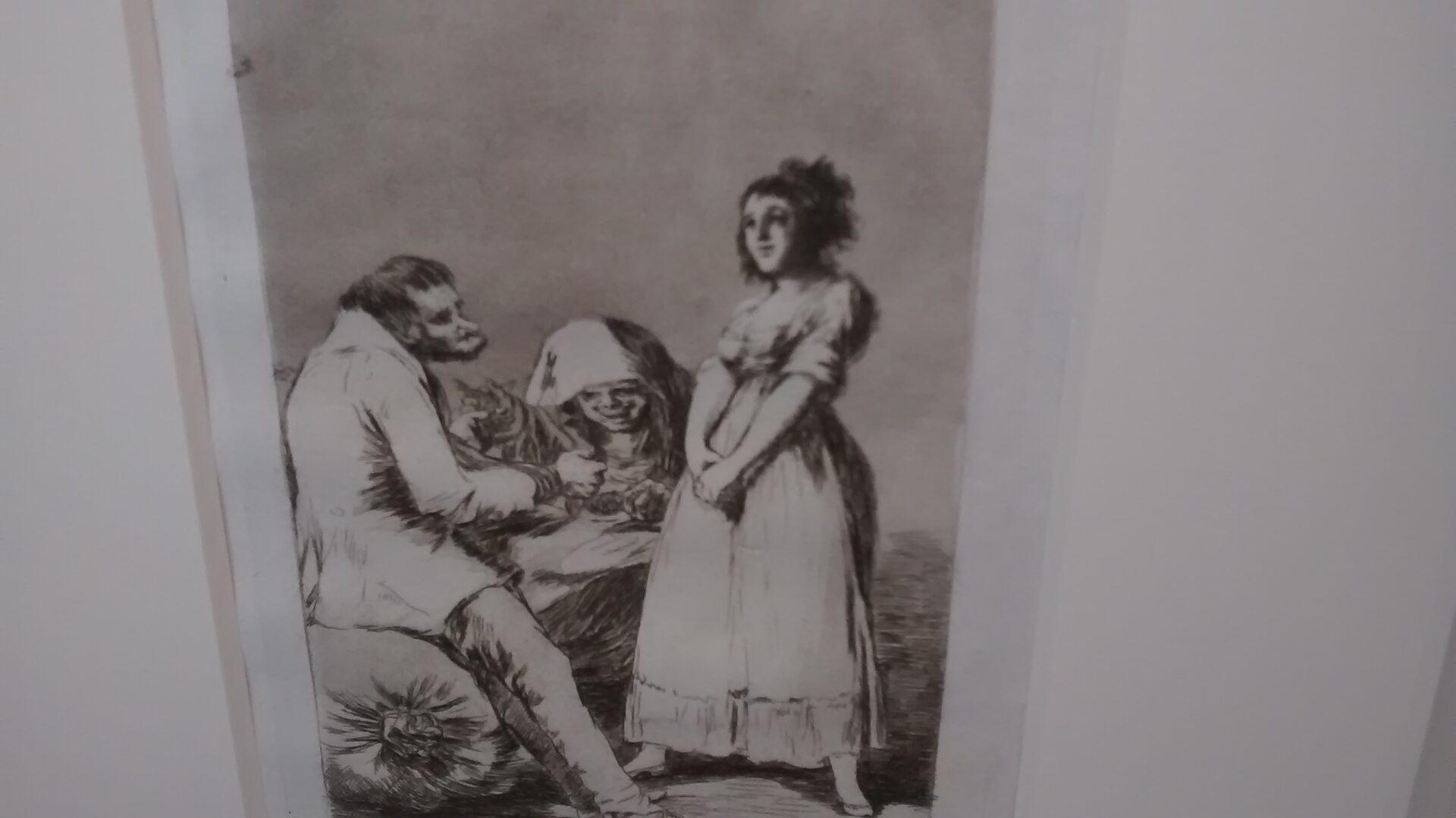
It has to be said however that not everyone recognized Goya as a genuine genius, and the great British critic and cultural commentator John Ruskin apparently once bought an entire folio of Goya prints solely for the personal pleasure of being able to throw them on the fire and watch them burn away. Whether you want to follow Ruskin’s foolish example or be a bit more rational and stick one on the wall, then the individual prints are each for sale at around the £8,000 mark.