
To Vauxhall tube station and off to a surprisingly good start when I successfully manage to guess the right exit to escape from this subterranean labyrinth and emerge into the daylight just where I want to be, round the back of the famous MI5 building. I can see a security woman here waving people in through a side door and, since she doesn’t seem to be checking anyone’s passes, I’m tempted to try and sneak in. As everyone knows, Daniel Craig recently resigned from the place so maybe it’s today that they’re having the open auditions to try to find a replacement. I suppose I could make a pitch for the role but I’m a bit busy these days writing the blog and I don’t really have the time to go chasing after baddies in speedboats or hang around in casinos waiting to be seduced by duplicitous temptresses. Nevertheless, I’d still quite like to have a quick nose round the inside of the building. It looks like such an odd piece of Post-Modern architectural whimsy from the outside that I’ve always wondered whether the designers continued the fairy-tale castle pastiche style inside. Is M’s office a mirrored room filled with massive chandeliers? And are there also perhaps hanging gardens, drawbridges, moats and an underground dungeon? In the end I decide that, discretion being the better part of valour, it’s probably best not to try to enter the fortress so, instead, just carry on walking along the Albert Embankment until Lambeth Bridge comes into view. At which point I turn away from the river and zig-zag through a few short streets in order to shake off any Smersh agents that may have been tailing me, and finally get to my destination: the secret, underground lair of that artistic mastermind, Damien Hirst. No, just joking, the Newport Street Gallery is not really a lair but a big, bright wide open, free entry exhibition space and it’s definitely above ground.
Launched a few months ago with a colourful show of splashy paintings by his old friend, Britain’s best-loved Abstractionist, the late John Hoyland, the Gallery is now hosting a display of work by another of his old friends, America’s best-loved Post-Popist, Jeff Koons. Actually, it’s very much easier to categorise Hoyland than it is Koons and I’m not sure that the awkward appellation Post-Popist really describes what it is that this rather smooth-talking artist gets up to in his studio. Or, rather, to what end he directs the assorted assistants and subcontracting craftsmen who work under his creative control. For Koons, himself, doesn’t so much make artworks, using the traditional skills of paintings or sculpting and the like, but selects items and repackages them for display. Sometimes this involves having an object recast from one material into another and scaling it up in size but, at the start of his career, he followed more directly on from the example of that most enigmatic of all artists Marcel Duchamp, and just relocated items from the hardware store into the art gallery and called it art. It’s just over a century since the French maestro first came up with the idea of the so-called readymade, whereby a simple utilitarian object like a wine rack or a snow shovel could be re-classified as art simply by dint of an artist declaring it to be so and then putting it on display, but the ramifications of this revolutionary concept are still being played out now, not least by Koons and Hirst.

Of course, the problem that most people have in accepting Duchamp’s notion that the mere act of picking out a wine rack or snow shovel and displaying it in an art gallery makes it art, is that the process doesn’t seem to involve the need for any particular skill.
Commonsense sort of suggests that it should, and that what defines an artist is that he or she can do things that most of us are simply unable to do, no matter how hard we try, whether it’s drawing a convincing representation of a scene, carving the likeness of a face out of wood or whatever. But Duchamp’s radicalism went further than just questioning the need for artists to possess a particular crafting or drafting skill since, when choosing his readymades, he deliberately selected the most mundane and uninteresting objects that he could find. Consequently, he was challenging not just the question of what constituted the process of making art but also what was the actual purpose of art. Tradition suggested that a work of art was required to evoke some kind of an emotional response in the viewer by being beautiful to look at or perhaps by telling a story that would inspire empathetic reactions of joy, horror or something in between. Duchamp, on the other hand, said it didn’t have to do any of these things although I’m not sure that he ever indicated what, if anything, it should be trying to do.
Which sort of brings us back to Koons and the selection of pristine vacuum cleaners and floor polishers, all neatly displayed in their own glass cases, that he picked as the readymades to start off his career in the 1980s and which now fill the opening room of the exhibition in Hirst’s Gallery. Looking at Duchamp’s originals, whether in Tate Modern or the Philadelphia Musuem of Art (which hosts the main collection of his work), is to be reminded of the arguments about the nature of art and artists that I’ve tried to draft out above. But, in the years following Duchamp first raising them, these debates have been endlessly chewed over, are well known to anyone with an interest in Modern Art, and no-one really needs to be reminded of them. Once they’ve been made, it’s hard to see the point of making them all over again. But if Koons is not doing that, then what is he doing?
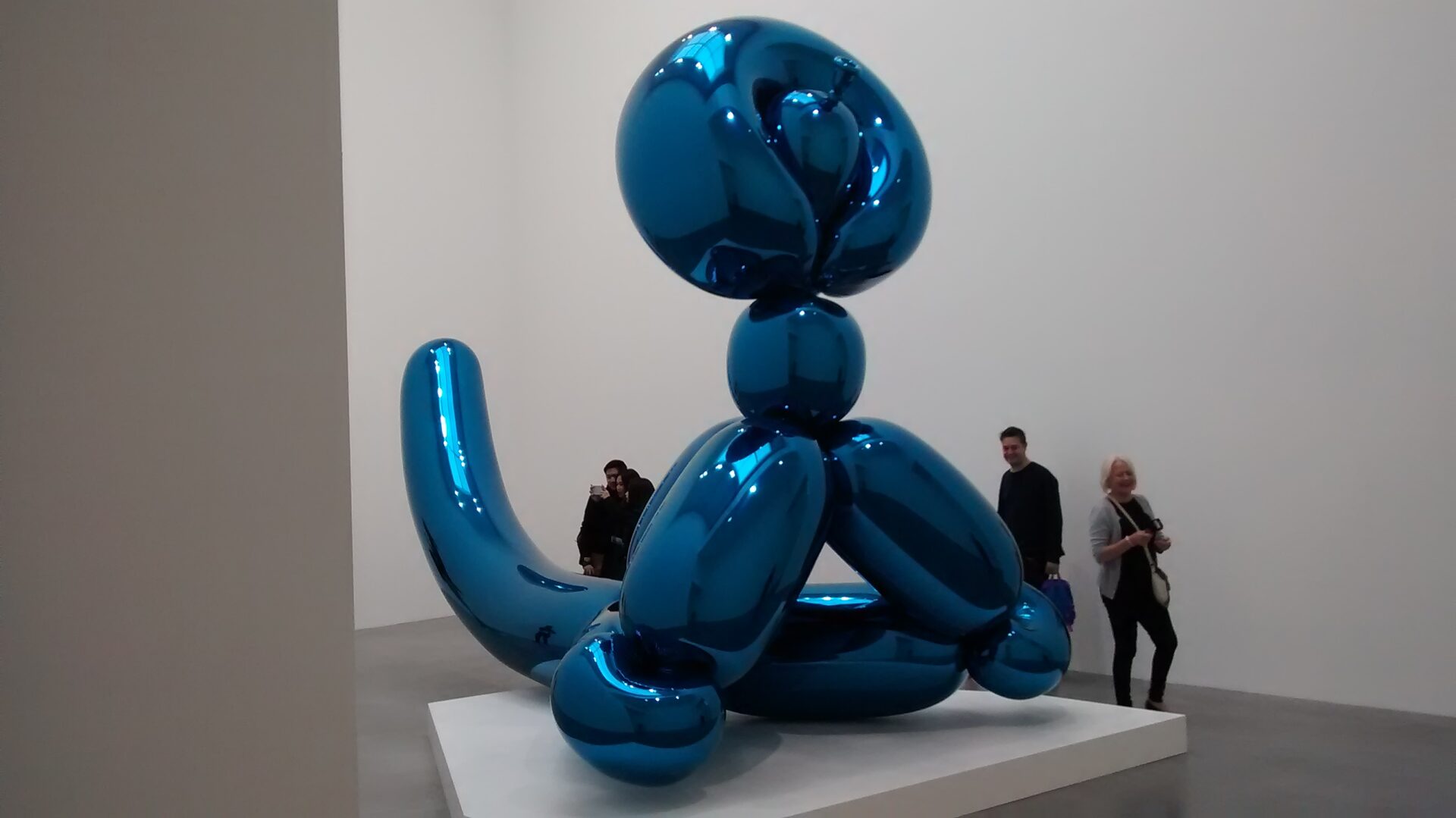
I think the answer comes when Koons moves on from making – or should I say selecting – his readymades and then starts to manipulate them. And it’s here that he draws again from the back catalogue of Modern Art ideas by revisiting the world of Pop Art and in particular the sculptural works of Claes Oldenburg, who famously made small object large and hard objects soft – think of the giant safety pin and the floppy, plastic drum kit. By deftly updating Duchamp and Oldenburg, Koons comes up with a whole series of what might be called manipulated readymades, the most famous of which is the dog twisted together out of a couple of party balloons that gets refabricated to massive, roomsize proportions in shiny blue stainless steel. Others examples here include a massive bowl of eggs, a lump of multi-coloured modelling clay and an inflatable lobster bathing toy doing a handstand balanced on a couple of chairs, all of which somewhat contradict Duchamp’s original decree that readymades should be deliberately uninteresting objects. Duchamp also made a very conscious decision to limit the number of readymades and I think he probably came up with just a dozen or so until he all but stopped making art, retired from the artworld and took up playing chess instead. I assume he too thought that, the argument having been made, there was no point in repeating it more than a few times. But if that reflected his own somewhat severe intellectualism I think it’s fair to say that both Koons and Hirst are cut from a very different type of cloth and share a devotion to what might be called entrepreneurial exploitation. Both artists seem to have realised that a big balloon dog, just as much as a killer shark, are going to attract a whole lot more attention and be much easier to market and sell than a wine rack or a snow shovel. And that in our current global free trade system, limits to the quantities of items made should not be based on some antiquated, self-imposed restriction reliant on a bit of arcane art theory, but purely on what the art market can bear.

Hence the rooms here are full of a career’s worth of glossy, trashy replications of the kind of stuff that would normally be found in a Poundland or, since Koons seems to have a particular penchant for inflatable swimming aids, in one of those shops that line the beachfront of most seaside towns. Part of me does wonder what on earth any of it is doing in an art gallery at all and, frankly, I find it hard to look at any of Koons’ work without being overwhelmed with what I perceive to be his sense of cool calculation and detachment. I’m sure that Koons doesn’t create anything without having spent a lot of time carefully analysing each aspect of his work, not just with respect to the traditions and precedents of art history and whatever happens to be swirling around in the miasma of contemporary art theory at the time but also with regard to all aspects of marketing, promotion and brand development. While there’s obviously nothing inherently wrong with an artist being a bit cerebral and thinking deeply about what he produces, the downside is that it can result in an exhibition like this which leaves me as emotionally and intellectually unstirred as a vodka martini.

Koons is the Trump of the art world.
Any nominations for who might be the equivalent to Farage, Bojo or Corbyn?
Well I always thought Damien Hirst was the Robbie Williams of the art world – cheeky chappie persona