
To South Kensington tube station and walk down Exhibition Road and past the swarms of eager kids and excited young parents heading off to see the dinosaurs, steam engines, inter-active computer displays and other marvels in the Science and Natural History Museums. Turning right into Cromwell Road the demographic starts to age a little and consequently the anticipatory shrieks and whoops diminish to a level of murmuring and muttering more comfortable for my ageing auditory equipment and more befitting of those about to enter the regal splendour of the mighty and majestic Victoria & Albert Museum. I’m here to catch another of their thematic design shows with the appropriately fantabulistic title of You Say You Want a Revolution which, to anyone of a certain generation – my generation, in fact – will automatically summon up the image of a juicy green apple label whizzing round at 45rpm on a record player and a growling electric guitar with a heavy fuzz box distortion introducing John Lennon’s melodious rock warblings. And the exhibition is indeed devoted to a look at the music, fashion and film of that most grooviest of decades, the stunningly super, sensationally sensual, sexy swinging sixties. Although, to be precise, for some reason, the show is only offering the images of half a decade, at least that’s what’s specified in the exhibition’s official subtitle: Records and Rebels 1966-1970.

Queuing up to get my ticket (£16 full price, and a slightly more reasonable £7.50 with a combo Art Fund card and oldies discount) I discover that it’s the last week of the show which has resulted in a sudden surge of late bookings and, consequently, the next time slot for me to get in to see the show is not for another couple of hours. I suppose I could wander round the permanent collections but it’s such an awkward building to navigate, with no logical path and with an incredibly random miscellany of art, artefacts and objets d’art, that I decide on an alternative course of time-killing action. In short, I continue walking up Exhibition Road to get to Kensington Road and then get a bus over to the Leighton House Museum. It’s a place I’ve been a couple of times before so I speed along past the permanent displays of paintings, ceramics, ornamental tiles, stuffed peacock and the other fitting and furnishings, with which the good Lord Leighton so tastefully decorated his house, and head straight for the studio area where there is a temporary exhibition centered around his late, great masterpiece, Flaming June.
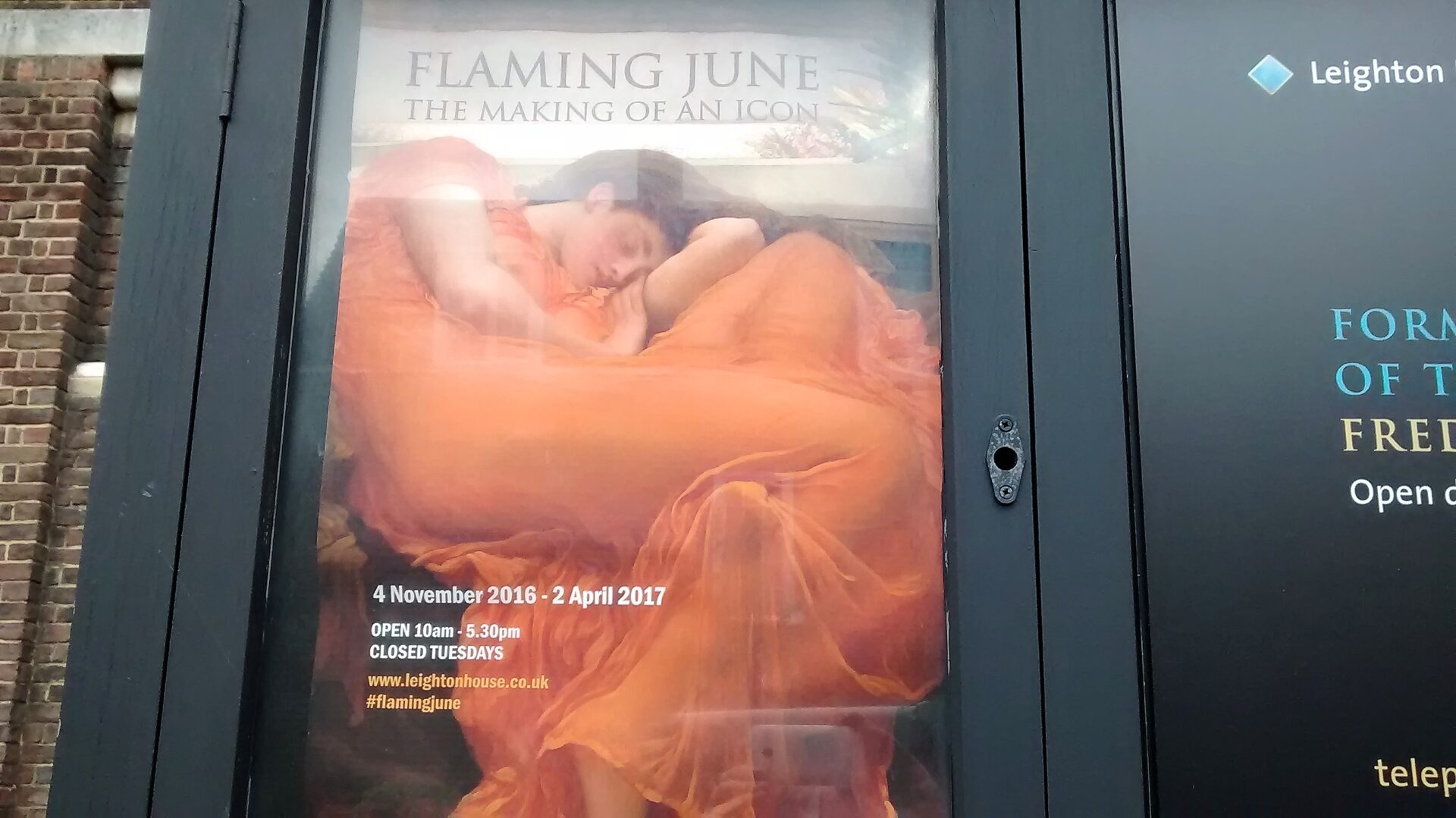
By way of an introduction to the main display, the curators have successfully rummaged around the archives and managed to find a whole selection of detailed preparatory drawings and sketches that confirm just how much time and effort the artist put into creating such a seemingly simple study of a young woman in a diaphanous orange negligee curled up asleep on a sofa. In fact, the pose is rather intricate and creates a highly original, swirl of limbs all contained within a circular outline that allows Leighton to show off his mastery of anatomy and foreshortening as well as his wonderful technical facility, exemplified by the way he so successfully represents the model’s subtle flesh tones shimmering through her teasingly translucent gown. I think it’s fair to say that it’s a truly bravura piece of painting of a very sensual scene and an image that once seen lingers long in the memory. I don’t know that it’s attempting to make any great moral statement or is liable to prompt any profound reflections about the iniquities of life and the way the world goes round but then, as far as Leighton was concerned, attending to those matters was simply ultra vires and beyond the artist’s remit.
By the same token, I’m sure it would be fairly easy to deconstruct the picture and reconstruct it into an argument about the appalling hegemony of the oppressive male gaze in Victorian society. But, at the risk of outraging any of my more uncompromising feminist acquaintances, I have to confess that stood in front of the painting I find myself disinclined either to formulate any kind of rationalistic, socio-political analysis of the artwork or try to weave it into some kind of critique of contemporary social mores. Instead, I’m just happy to succumb to enjoying the sheer sensual pleasure evoked by this particular arrangement of shapes and colours and tones. And, having been familiar with the painting for quite a while, seeing the image reproduced in assorted books and catalogues, it’s definitely a pleasure to be able to see it for the first time in the flesh, as it were, on loan from its usual residence, in the Art Museum of Puerto Rico.

Either side of the main attraction, the curators have also managed to locate, borrow and rehang five of the other works that Leighton also painted around the same time in preparation for display at the Royal Academy Summer Show of 1895. In effect it’s a recreation of the private display that the artist customarily used to organise in his studio to allow certain privileged guests to preview works that were destined to be shown in public later in the year. These other paintings, similar sorts of allegorical excuses to portray striking portraits of unnamed female models, are all very proficiently painted and impressive in their own different ways, yet none is quite as flamboyant and perfectly realised as famous Flaming June. Rather poignantly, this selection of works, created when Leighton was in his mid-sixties and arguably at the peak of his painterly powers – and now gathered together to be displayed for the first time in over a hundred years – represents something of a requiem to the artist. Tragically, within a year of their original exhibition Leighton had died of a heart-related illness
At which point it’s time to scuttle back to the Victoria & Albert Museum where I arrive with half an hour to spare. On another occasion, I’d probably fill the unforgiving thirty minutes by checking out the ground floor gallery filled with the extraordinary Raphael cartoons but, in keeping with my previous visit, it seems not inapt to head past the central help desk, continue on through the shop and then take a right turn into the sculpture court and up the staircase and right again into the hallway opposite the National Art Library. For here is another example of a major work by Leighton, one of the pair of vast murals that the Museum commissioned in 1868 to provide decorations at either end of what was once a large open gallery space. Doubtless for the best of logistical reasons, structural alterations now mean that the display area is totally transformed and that instead of being able to view the murals from an appropriate distance of a hundred feet or so, the viewer can now only get about six feet back from the painting. This, it need hardly be said, is a somewhat less than ideal position to be able to appreciate the full wonderment of the Neo-Classical scenes of various muscular youths and other toga’d totty posing on the waterfront in a scene entitled The Arts of Industry as Applied to Peace. For me the contemplatory mood is also somewhat lessened by a gaggle of schoolchildren who start racing along the corridor and yelping excitedly. Presumably they’re expecting to turn a corner and find a dinosaur, steam engine or interactive computer display and haven’t yet realised that they’ve entered the wrong building.

Anyway, it’s now time at last to travel back fifty years and briefly relive those happy hippy days of yore, courtesy of the V&A’s Revolution exhibition. Although maybe the curators should have simply called it the Sixties Show as that seems to be the approximate age of most of those in the queue near to me as I line up to get the complementary headphones that pipe out a non-stop medley of pop hits of the era. As for the visuals, well, I suppose the main surprise is that there aren’t really any surprises. It’s a bit like someone has got an intern to research the project by watching a couple of Austin Powers movies and then done a google search for all the most obvious symbolic images of the so-called ‘60s counter-culture. So, the show starts with the famous photo of Christine Keeler and the Larkin quote about sex and the Beatles’ first LP and then moves on through Twiggy in a mini-skirt, Peter Blake’s Sgt Pepper collage, Jimi Hendrix psychedlia posters, Oz magazines, film clips from Woodstock etc, etc, etc before ending with John Lennon singing Imagine. In other words, it’s all a bit corny, and conventional. Or maybe I missed some of the less standardised stuff while I was pushing, shoving and barging my way past all the other shuffling old hipsters as I struggled towards the exit in an effort to escape from yet another exhibition allowed to become crammed with far too many other people.

With the exhibition atmosphere insufficiently conducive to prompt a pleasant nostalgic wallow and the content so undemanding and unquestioning of the official cliched version of events as to be unmindblowingly uninteresting, the whole show struck me as being – if you’ll pardon my lapse into the vernacular of the period – a bit of a bummer, man.
