
To Charing Cross Road and across Trafalgar Square where the hordes of happy tourists are, as usual, clambering all over the famous Landseer lions that stand at the base of Nelson’s Column. And, considering the rough treatment to which these big bronze beasties are subject every single day, they still look in marvelous, near pristine condition. Which makes me kind of think that maybe the public should be encouraged to climb up onto other famous landmark works of art and show their similar appreciation by giving them all a bit of a polish. Paolozzi’s rather too chunky version of Newton that sits outside the British Library looks like it would be easy enough to scale and I suppose there’d be a certain poetic conceptualist drollery in getting to stand on the shoulders of this particular giant. And, for the more adventurous free climber, edging a way up the north side of the ornamented marble gazebo memorial in Kensington in order to give poor lonely gilded Albert a great big hug might provide a worthwhile and rewarding challenge.

Oh well, enough of this Performance Art silliness and on to the Mall Galleries which provides the venue for this year’s 20:21 British Art Fair. The show always used to find a home in the Royal College of Art (just across the road from the good old Albert Memorial) but evidently circumstances conspired to require a relocation to this smaller, if perhaps more attractive, space in central London. So, what’s the show like? Well, there are a couple of outliers, but otherwise I think it’s fair to say that most of the thirty-plus commercial galleries showing here today are respectable, well-established – some might reasonably say conservative – purveyors of good old fashioned Modern British Art, if you’ll pardon that slightly oxymoronic construction. Anyway, there’s none of the yobbery of the Young British Artists, little even of the brash exuberance of the ‘60s Pop Artists and, instead, just a good solid selection of works by an earlier generation of gentlemen and gentlewomen artists of the likes of Terry Frost, Ivon Hitchens, Alan Davie, Frank Auerbach, Elizabeth Frink, Eileen Agar, Henry Moore, Keith Vaughan, Graham Sutherland and, well, I could go on and on. And clicking though my rolodex memory of the stuff that I saw at the show today confirms the fact that there really is quite a surprisingly healthy number of artists from these sceptred isles who were, if not all of absolute first division ranking on the international stage, still capable of producing a very considerable stream of consistently interesting and attractive imagery.

Most of galleries showing work here are situated in London and could, of course be visited at any time during the week but gathering them all together in one place certainly makes it easier for the art rambler to conduct one grand sweep and so make a mental note of all their various different speciality areas. And, since the Fair is essentially a commercial enterprise, most of the galleries are also happy to annotate the little labels that accompany each of the works on display with not just the name of the artist, and the title and date of the work, but with that other, most vital descriptor, its sale price. It’s a practice that can be very helpful, since it avoids the need to ask how much a particular artwork costs – an enquiry fraught with potential embarrassment and awkwardness, especially as the ever-so elegant receptionists that so often seem to staff these commercial galleries appear to take such great sadistic delight when given the opportunity to quote a very high gross figure to a very obviously low net worth individual, such as myself..

Having said all that, while naturally none of the art on display here is particularly cheap, some of it does seems quite good value to my amateur eye. The rather lovely early John Hoyland print at Gwen Hughes Fine Art for £1,600 looked very reasonably priced and, for those with a rather larger budget, so did a couple of Bomberg portraits for £40,000 each from the Boundary Gallery. Other items that caught the attention and repaid a second look included the quirky surrealistic photographs of Angus McBean, at Pierre Spake; the hectic sketches of Felix Topolski at Sim Fine Art; and the organic abstracts of Paule Vezely at the England & Co stand.
So, all in all, quite a good round up of mini-displays to start the day before taking a shortish tube ride to get to Pimlico and Tate Britain for the Rachel Whiteread retrospective. Which, I feel, allows the opportunity to switch briefly away from the usual reportage reporting bloggery to include a couple of personal paragraphs of biographical anecdote and so stake my claim for inclusion in a minor footnote posting in the annals of the great art historical record. And this comes by way of reference to the famous Sensation* exhibition that filled the galleries of the Royal Academy in 1997 and was, of course, the moment when the art establishment finally acknowledged the validity of the so-called Young British Artists and bestowed their haughty imprimatur upon the bunch of scallywags who had recently been giving such a rude, radical jolt to the comfortable quiescence in which the traditional contemporary artworld had otherwise been gently stewing. Norman Rosenthal, the exhibitions secretary of the Academy who had co-curated the show, wrote in the catalogue of the excitement of the time and specifically noted the occasion when a callow young Damian Hirst insisted in driving him off to see an exhibition by Rachel Whiteread that was then showing at the Chisenhale Gallery. At the time I happened to be company secretary for Art Place Trust, the charity responsible for running both the Chisenhale Gallery and Studios, which were located in the same building. And, as my diary records, I was the one who literally opened the Gallery door that day and invited in this unlikely pairing of youthful enfant terrible and important art world luminary to gaze upon Whiteread’s Ghost, a life-size cuboid white plaster cast of a room that was stuck like a great silent monolith in the middle of the Gallery floor.
The Whiteread show had opened a week or so earlier and, again, I can recall at the private view listening to the artist Richard Wilson who was animatedly expatiating about the wonderfulness of the massive sculpture while I half-heartedly nodded in bemused agreement while crossing my fingers behind my back. I thought the work was ok-ish but was, frankly, baffled by the heaps of praise that he, and everyone else, seemed to be showering upon the artist and her work. Anyway, I think it’s fair to say that that exhibition definitely helped launch Whiteread on her fabulous future international superstar career for which the current Tate Britain show provides the latest highpoint.
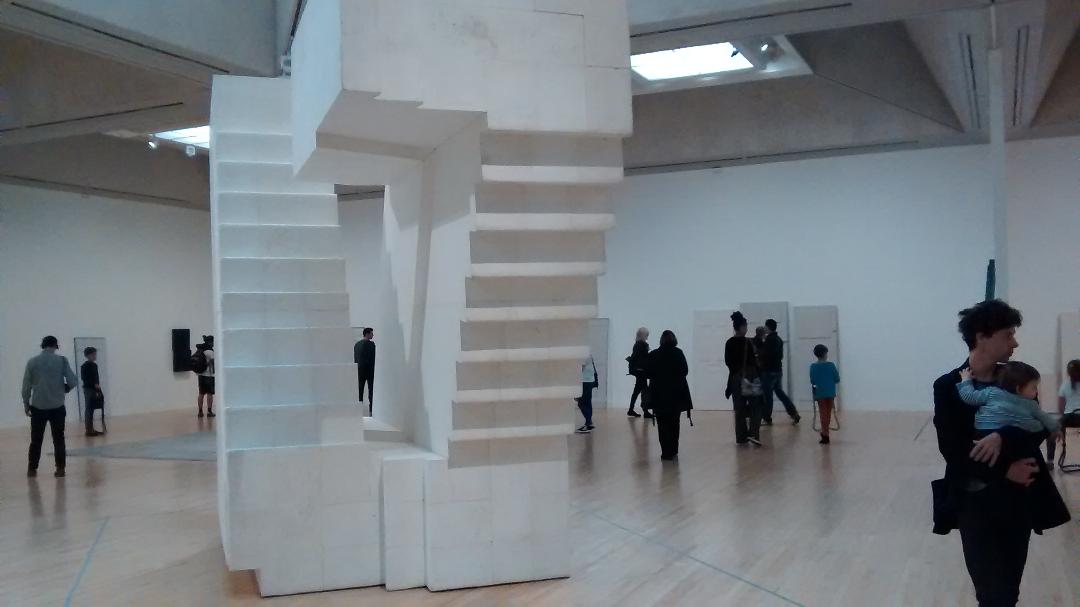
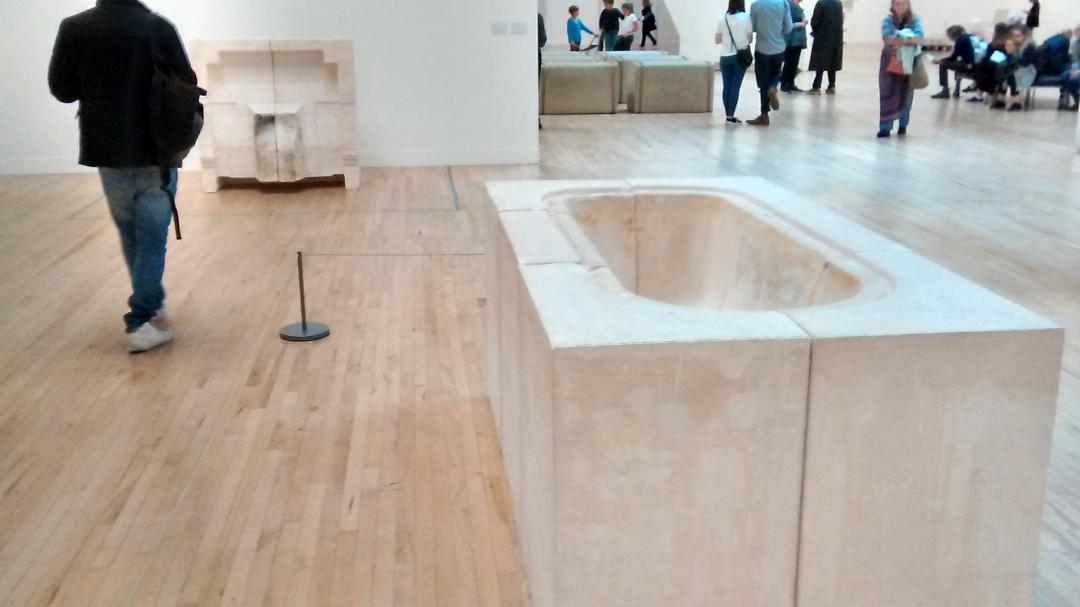
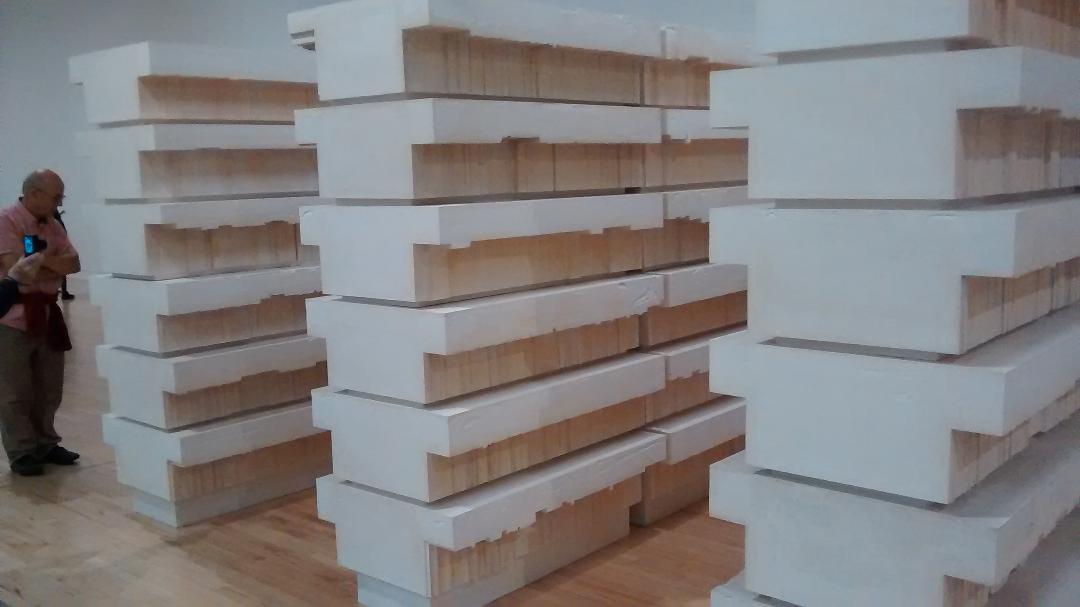
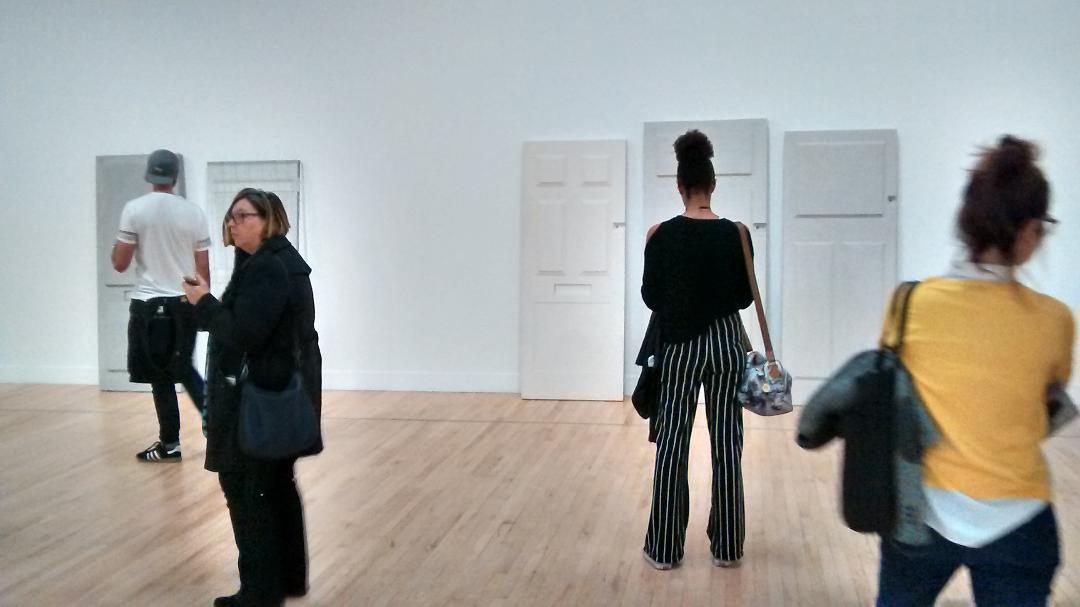
So, what’s the current show like and have I changed my mind and become more enthused about her work? Well, yes, no, maybe is the answer to that. But, first of all, I think it’s worth pointing out that the current curators have done the artist a terrible disservice by staging the exhibition as one, great open-plan display. Just about all the dividing walls of the gallery space have been taken away so that instead of the traditional pattern whereby the viewing public are led through a series of sequential room that mirror a sort of chronological pathway, showing how the artist has developed different styles and themes over the passage of time, everything is visible all in one go, all at once. Not only does it make it very much more difficult to discern any artistic evolution or development but it also means it’s just not possible to properly concentrate on the subtlety of any individual piece, since there are always three or four others making their inevitable distracting interventions in the background. I honestly can’t see any upside to this very odd layout design and think it rather dooms the exhibition to being a bit of a dud from the very outset since the one thing it really does emphasise is just how narrow is the creative path within which Whiteread has chosen to restrict her artistic explorations over the past thirty-or-so years. And while it would perhaps be a bit too critical to describe the artist as a mere one-trick pony, the number of prestidigitative products in her repertoire could very probably be counted on the fingers of the hands of a one-armed man. So, there are the large-scale white plaster casts of rooms, furniture and fittings – tables, staircase, sink, bath, fireplace, doors etc; the small-scale plaster casts of hot water bottles that resemble dismembered torsos; some slightly more colourful resin mouldings taken from the undersides of randomly collected chairs; and the replica castings of a bunch of discarded old mattresses. And I’m not sure that there’s very much else. And while it’s true that all of the above come in a variety of resin, plaster, rubber and other material formulations, there’s very little variation from the matt white and putty grey tones that dull and muffle the exhibition under a snow-like shroud.

On the plus side, all the works look quite pretty in a minimalist sort of way (that, I repeat, would surely be more easy to appreciate has they been better displayed) and occasionally – it feels almost accidentally – some of the individual works do, I concede, manage to achieve a greater standing. The resin copy of a mattress left against a wall that sits and sags so dispiritedly, inevitably makes one think of its past owner, or owners, and imagine the history of all the nights of sleep and coupling and dreaming that are, almost literally, embedded therein, prior to its own casual, brutal retirement. And a similar, quite powerful resonance also sparks into life on those rare occasions when Whiteread allows smears and traces of elements of the original fittings to remain staining the moulds that she then takes and displays. Whether it’s the sooty residue on the fireplace or the dabs of colour drained from the books that once lined the serried ranks of empty shelves, again this viewer is nudged into a train of thought that encompasses all sorts of notions of mortality and the scarce material impressions that are all most of us are destined ever to leave as memorials to our own transient existence.

Unless, perchance, one takes to blogging in which case it’s the digitised immortality of a place within the internet cloud that awaits.
*While Whiteread was included in the Sensation show, I don’t think she was ever really part of the YBA crowd and was certainly far too pleasant and polite to ever want to be a member of its yobbist tendency as personified by Hirst, Sarah Lucas, Tracy Emin, Marcus Harvey, or the Chapman Brothers, who all very deliberately used shock tactics to draw attention to their work.