
Head over to Piccadilly tube station and then stroll down to the Royal Academy and up into the Reynolds Room for another lecture linked to the current Dali-Duchamp exhibition. As regular readers may recall, a couple of blogs ago I spent an hour listening to Paul B Franklin expatiating on the merits of Marcel’s Large Glass and now I’m back to hear Dr Fiona Bradley devoting her sixty minutes to an appraisal of Salvador’s Christ of St John of the Cross. Perhaps unsurprisingly, Bradley is a big fan of the Spanish Surrealist and can’t help making reference to the iniquitous behaviour of the self-appointed arbiters and taxonomic rankers that have positioned these two artists at opposite ends of the artworld hierarchy. As she’s forced to admit, the consensual opinion of all the bien pensant experts is that while every single squeak of Duchampian exposition should be analysed and idolised, and their reluctant hero placed firmly on the very pinnacle of the Olympian peaks of grand mastery, poor old Dali must be denounced as a showman, charlatan and fraud who should be excommunicated, placed beyond the pale and generally left out in the wilderness to wither away in oblivion. But it’s not just their relative positions within the league tables of professional critical appraisal that place this pair at antipodal extremes, the couple are the near personification of opposing artistic stances from their introvert-extrovert personalities to their figurative-abstractified compositions and from the gushing prodigality of production of work from the one to the extremely parsimonious output of the other. In fact, the idea of an exhibition dedicated to trying to explore connections and complementarities between the two seems dafter and dafter the more one thinks about it. A situation entirely unaltered by the actuality of being able to see examples of their work in close proximity, for which this current exhibition now provides a rare opportunity.
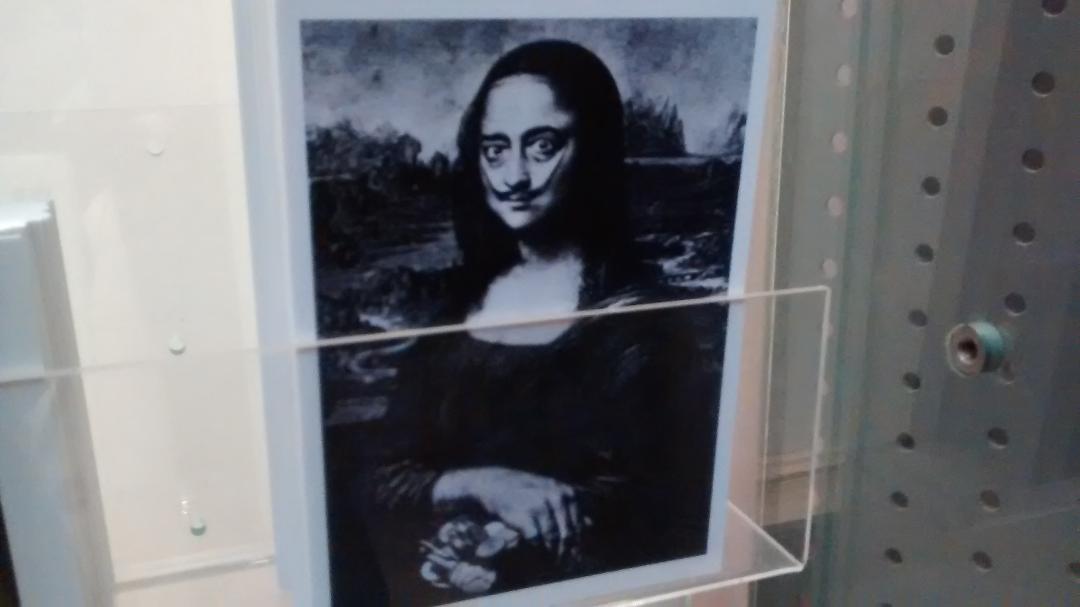
Indeed, Christ of St John and the Large Glass, which perhaps represent the dual highlights of the Dali-Duchamp show, could very well be taken as exemplars of visual artworks taken from the extreme poles of the 20th century Modernist canon, and perhaps even indicative of the breadth of expression encompassed therein. Certainly, Bradley in her lecture did nothing to try to suggest connections between the two artworks and, instead, talked mainly about Dali’s near religious obsession with playing with ideas of blasphemous representation and how the Christ of St John was a sort of sacrilegious self-portrait pendant to the paintings of his wife Gala posing in the role of the Virgin Mary. It’s an interesting idea but I can’t help thinking that if Dali had really wanted to suggest that he was somehow the man up on the cross, he would have painted on a signature moustache and given him less of a Hollywood cheesecake physique. Frankly, I always assumed that the exceptional perspective of the composition – peering down on Christ instead of looking up, like every other crucifixion scene – and which, after all, is the single most striking aspect of the painting, meant that Dali was aligning himself with the other almighty creator and showing how God had viewed the temporary termination of our saviour. It’s an interpretation that I mentioned to the good doctor during the post-lecture Q&A session, and apparently the idea had never occurred to her before, which seemed a bit odd coming from such a well-qualified academic.
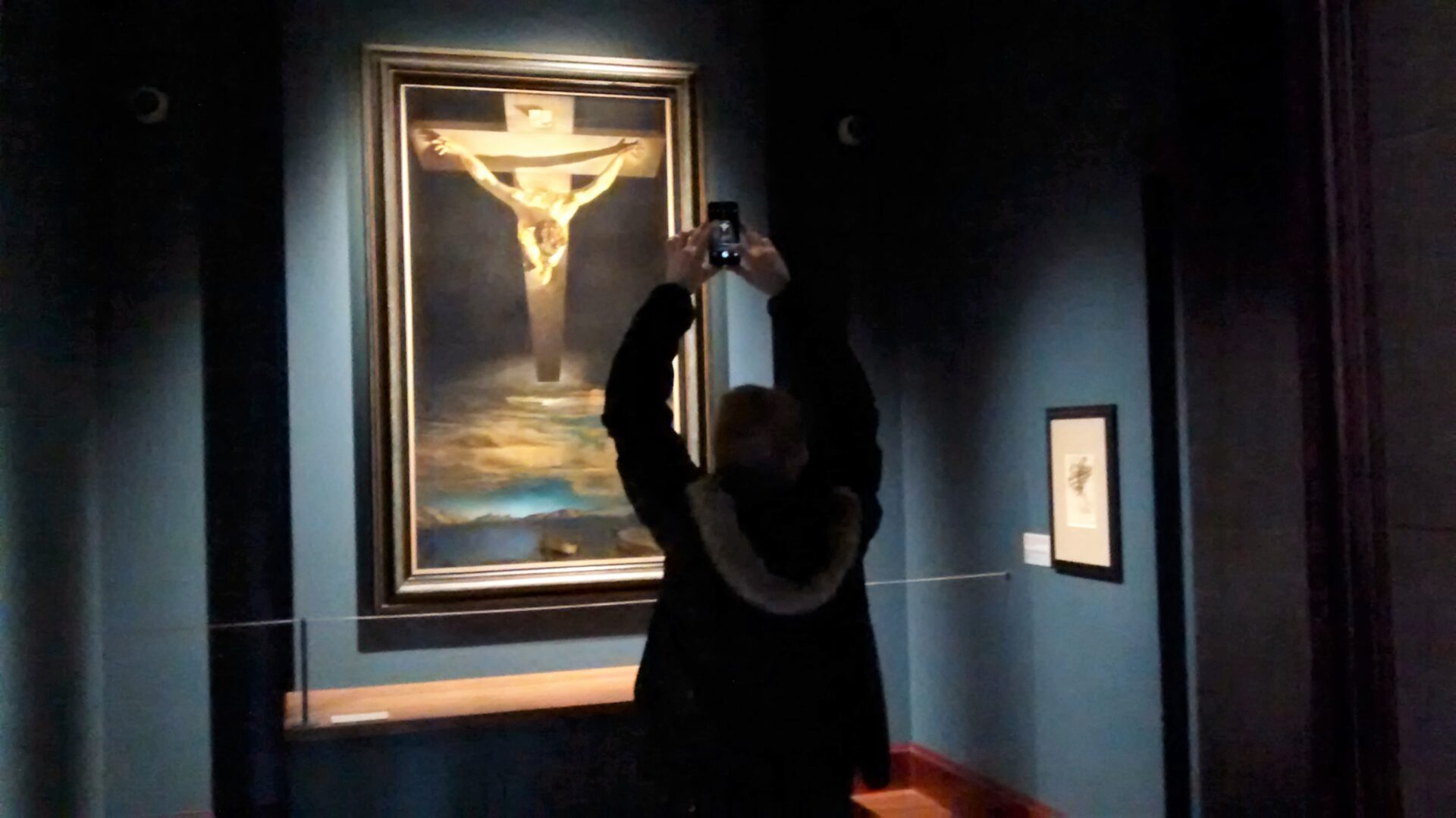
Anyway, I think both of us are probably agreed that it’s a stunning image, a bravura piece of painting and one that certainly appeals to general public, even if its temporary relocation to London will almost certainly be insufficient to improve, let alone resurrect, Dali’s reputation with the proper artworld cognoscenti. Of course, the painting usually lives up in Scotland at the Kelvingrove Museum where it has its own special little alcove (and where the accompanying photo was taken a year or so ago). And it has to be said that that’s a much better setting than its current situation, cramped in a room with Richard Hamilton’s copy of the Large Glass, various other assorted paintings, films and the concomitant crowds of bustling onlookers. Nevertheless, it was very generous of our cousins in the north to allow one of their most important treasures to travel down to the metropolis – a noble gesture that also provides the slightly tenuous connection that now helps transport me to the National Gallery to examine another Glaswegian loan, this time in the form of a collection of Degas pastels normally held secure in the vaults of the Burrell Collection.
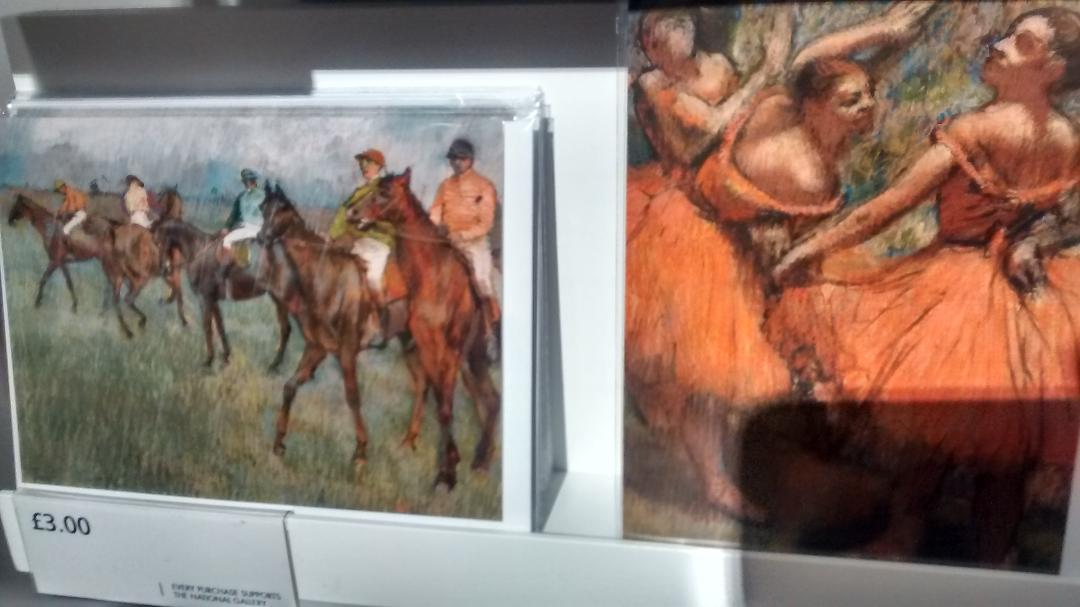
The show, timed to coincide with the centenary of Degas’ death, is a pretty enough display, containing examples of all the familiar themes that the artist used to encapsulate his quotidian vision of Paris at the close of the 19th century. So, there are horses and riders readying themselves for the race; plump little ballerinas, straining on the stage and relaxing at rehearsal; a bored laundress; a fashionable young woman out perambulating with her parasol for protection; and various other characters, all seemingly unaware of their having been spotted, squared-up and recorded for posterity. Compositions vary from the quick sketches to the more worked up designs but all give that most Impressionistic impression of having been captured in the blink of an almost unconsidered moment, and which was the modern way of rebutting the staginess of all the precisely posed and ever so carefully arranged studies that had defined the contours of French art from the previous Classical era. One way of achieving this would-be oxymoronic effect of a carefully calculated spontaneity was by deliberately cropping the imagery in an unexpected manner, and Degas sometimes seems to delight in pushing this effect to a quite unreasonable extreme. On at least one occasion he callously bisects one of his dancers, allowing exactly half of her to remain within the frame when, with just a little forethought, he could surely have squeezed her whole entirety back into the picture. But if the results of this kind of arbitrary trimming echo the sort of objective honesty reminiscent of the naïve snappings of an amateur photographer, then Degas’ other favoured technique cannot claim the same ingenuous origin. As the artist himself admitted, all those scenes of women bathing, washing and drying themselves that are such a prominent part of his oeuvre – and there’s a fair selection here – are presented as if viewed straight through the keyhole. When they were created a century ago, it was probably still possible to argue that the clumsy, sometimes ungainly, poses caught this way were more realistic, natural and less contrived than the elegant perfectionism that had been the preferred style since Renaissance times. But for a contemporary audience, things are much more problematic and being placed so obviously in the position of the voyeur can be decidedly discomforting.
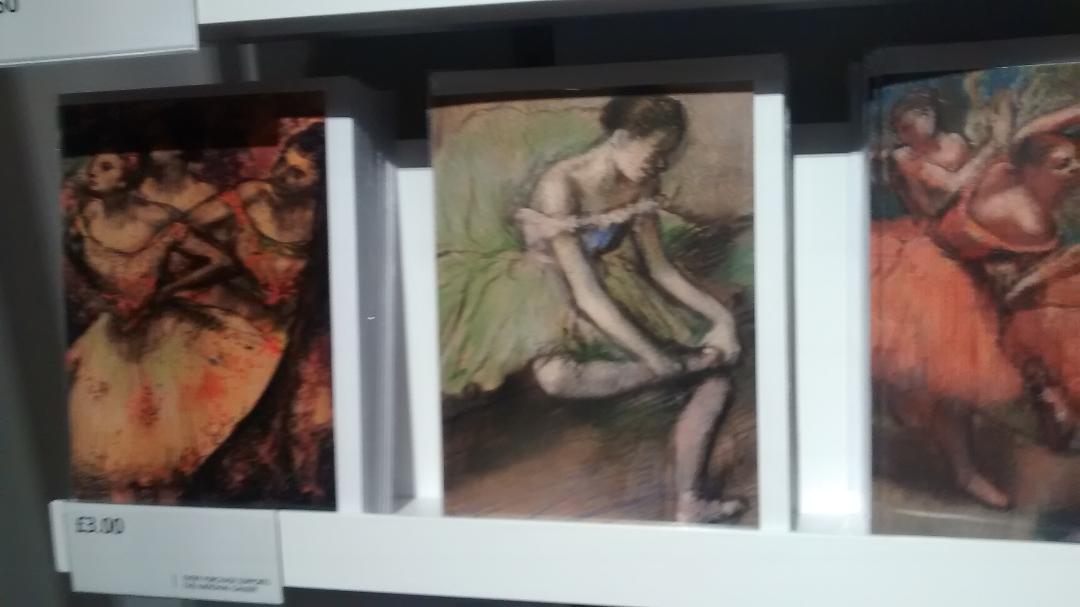
The final few works in the show are from the National’s permanent collection and include the large pastel of a maid combing her mistress’ hair. But if this sounds like a dreadfully quaint or cornily sentimental kind of a scene, to me at least, it remains an incredibly dynamic work of art. Degas blurs the details and limits his colour scheme to a short spectrum of shades that runs through orange to red and pink so that even though the picture may be very familiar it still retains that curious quality of remaining forever fresh and intriguing wherever and whenever one comes across it.
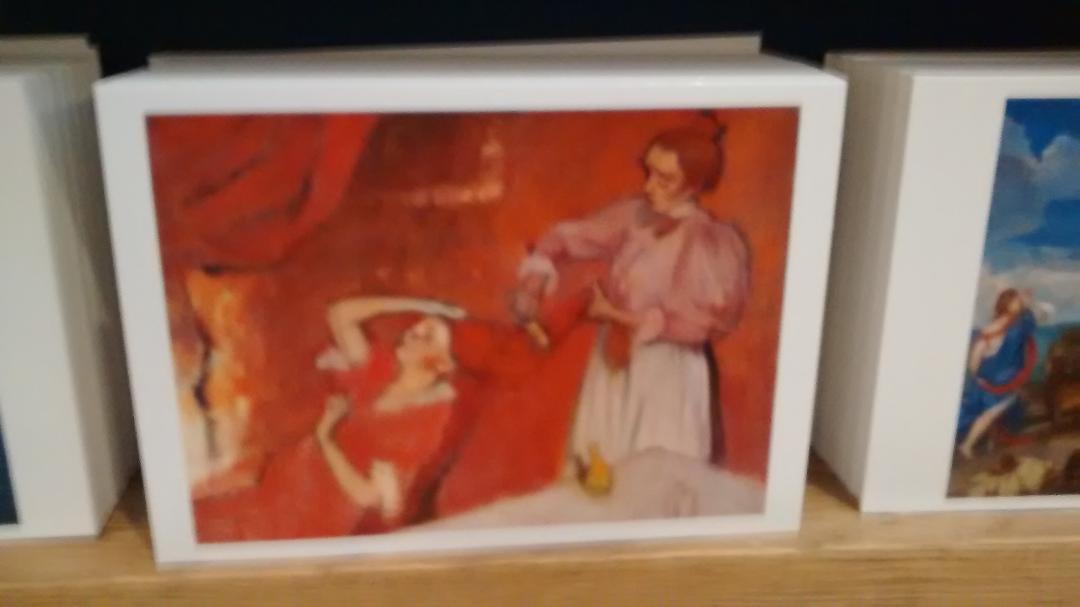
There’s no charge to get into the Degas show which makes it easy to recommend going along and taking a look. As for the other two shows at the National that have entry fees, well, I think instead of paying a combined charge of £24 it would make better sense to spend an hour or two wandering around the main collection and then use the money saved to buy some Christmas cards or decorations from the shop. Reflections seeks to expound upon the influence that Van Eyck’s famous Arnolfini Portrait had on the group of artists who sheltered under the rubric of the Pre-Raphaelite movement. Apparently the Portrait was a favourite of Millais, Hunt and Rossetti who admired the reality, clarity and precision of Van Eyck’s brushwork as well as the composition with its accumulation of manifold symbolic props – and they also liked the convex mirror at the back of the picture that casts its magical reflection out of the picture frame and into the real world of the viewer’s perspective.

Well, the Van Eyck is undoubtedly a great painting but since it’s part of the National’s permanent collection it can usually be seen for gratis. And while it’s quite interesting to see it set among some Pre-Raphaelite pictures, the case for the cross-cultural connection is convincingly made with reference to quite a small selection of works, after which a struggle unfolds as to how to fill up the rest of the show. The answer comes with some decidedly Post-Pre-Raphaelite stuff including a couple of Orpens, a Gertler and a curious copy of section of Velazquez’s Las Meninas (well, it’s got a mirror in it). I suppose it’s all quite interesting but not, I think, worth paying an entry fee to see.

Finally, Monochrome, the other entry-fee charging show, is a thematic investigation of the way various artists have for various reasons decided to dispense with their coloured palette and limit themselves to working with selected shades of black, white and gray. Sometimes this is to show off a technical ability to emulate the forms of statues or reliefs; or to make a symbolistic theological point about the deprivations of Lententide; or reflecting the logistical limitations of early printmaking techniques; or, more recently – for the show includes work from Renaissance through to Modern times – to satisfy the aesthetic amusement of Irish abstractionists like Riley and Kelly (Bridget and Ellsworth). Ultimately, the show makes one point very clear indeed: that the world, natural or painted, undoubtedly looks a whole lot better when seen in all its full colourful majesty.
