
It’s the start of a new year and the weather is pleasantly mild but there are grey skies looming above and the city looks desolate and empty as I walk out the tube station and over Blackfriars Bridge. I suppose most people are still sensibly sat at home, slowly recovering from last night’s sybaritic excesses and dulled down as they try to shake off that anti-climactical sense of ennui and trepidation that seems to enter the soul as soon as the celebratory displays have ended and the last of the sparkling fireworks has traced its transitory path across the sky, fizzled, sputtered, extinguished itself and finally fallen back to the ground with an unrecorded whimpering thud. But then, as I enter Tate Modern and start descending the ramp that leads down into the Turbine Hall, I notice a growing chorus of squeaks, squawks and squeals and realise that this heart-warming chorus of innocent exuberance is emanating from dozens of manic little toddlers all scrambling about on the floor, eagerly egged on by the encouraging calls of their enthusiastic young parents. So it is that just as one tired and tarnished old year stumbles to its pitiful conclusion, another youthful one emerges, powered again by the kind of fresh visions and aspirations characteristic not just of inexperience and naïvety but also of energy, determination and – dare one say it? – hopeful audacity.

And what could be a more apt symbolic representation of seasonal renewal and a more optimistic expression of the potential possibilities awaiting us all in our new and, as yet, uncharted future, than bunches of guileless little children all randomly running about, bumping into each other and falling down? On the other hand, I can’t say I’m really in favour of turning what is meant to be an art gallery entrance into a kind of temporary kindergarten for trendy metro mummies and daddies to parade their over-privileged progeny in a frantic attempt to virtue signal their own liberal good-parenting techniques. So, what has prompted this outbreak of totally inappropriate parental behaviour? Well, it’s just the latest attempt to stick something vaguely artistic into the vast and empty unforgiving expanse that takes up most of the Tate Modern ground floor. And, once again, the end result has proved to be embarrassingly feeble and uninteresting…except, evidently, to an audience whose highest intellectual encounters so far have been interactions with Tinky Winky and Peppa Pig. And, frankly, without the forced encouragement of their knowing parents, I doubt whether even this tiny-tot demographic would really be that impressed or engaged with the special stripey-coloured carpet, twirling silver globe and set of swings that a Danish art collective, who call themselves Superflex, have installed in the Turbine Hall in the latest dismal failure to detoxify this particular poisoned chalice of a commission.

Needless to say, the reason that I’ve come to Tate Modern is not to waste time looking at all this child-friendly, childish nonsense but rather to check out the retrospective of works by Amedeo Modigliani, the famous Italian artist whose distinctive portraits are probably among the best-recognised and well-liked of all the works of art that help comprise what is considered to be the essential Modernist canon. Originally, I’d intended to write a blog linking this exhibition with the Cezanne show at the National Portrait Gallery and the small display of Soutines currently on offer at the Courtauld Gallery, but when I looked at them all back in November I managed to bump up against the barrier of my word count limit before getting through the doors of the Tate and so there was no space to fit in anything about the moody Mr M. Nevertheless, I think these three shows do form quite an interesting sort of complementary triplet, and there are definite echoes of both Cezanne’s Post-Impressionist portraiture and Soutine’s Expressionistic caricaturing reverberating throughout most of the roomfuls of Modigliani on show here today. In fact, The Cellist, one of the very first works the visitor gets to see on entering the exhibition, copies not just Cezanne’s awkward, uncomfortable shifting sense of perspective and utter disregard for anatomical exactitude but also uses the exact same subdued palette of blues and oranges that the French master once used to piece together his pictures of pipe smokers and card players. But if those aspects indicate Modigliani’s willingness to look back to some of the radical art of what had emerged during the relatively recent past, then it’s clear that he was equally interested in taking on board the even more revolutionary contemporary developments taking place in the early years of the new 20th century. Witness the reference to the Cubist compositional trick of continuing the sweep of the musician’s jacket onto the patterning of the wall paper behind and the Futurist representation of movement shown by the blurred bow scraping across the strings of his instrument.
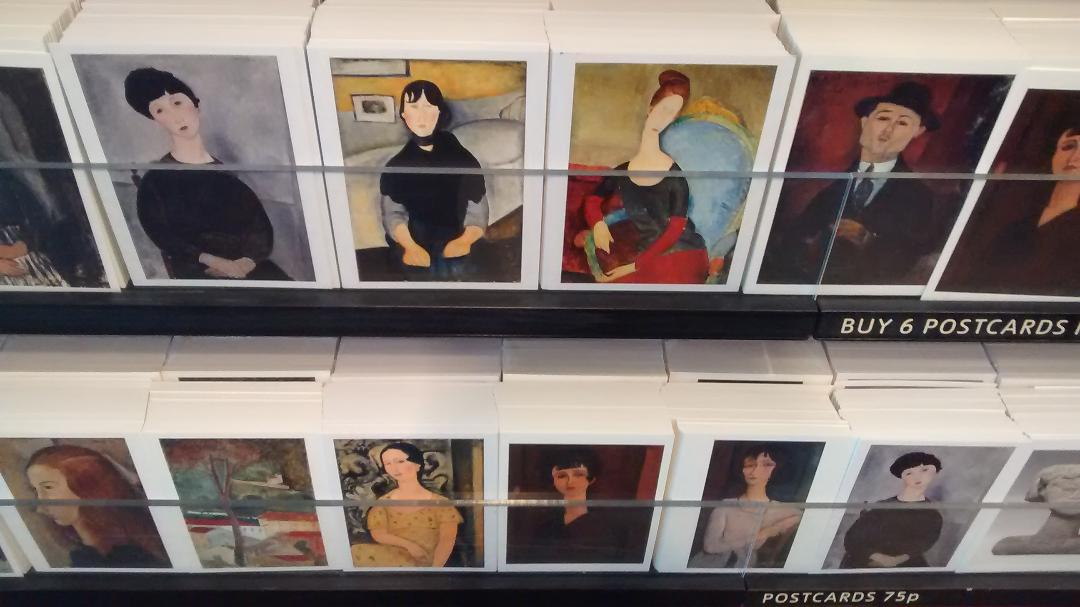
The single most important artistic influence on the youthful Modigliani at this time, however, appears to have come from another émigré enjoying the hothouse atmosphere of Parisian avant gardism. And it seems that his friend, the Romanian sculptor Constantin Brancusi (a sketchy unfinished portrait of whom appears on the reverse of the Cellist painting) even managed to persuade Modigliani to put down his brushes for a couple of years, grab a hammer and chisel and started bashing away at small blocks of limestone. The room full of the heads that then emerged from this sculptural diversion is perhaps the most interesting part of the whole exhibition since it shows how the artist, obviously somewhat constrained by the technical limitations of his novitiate status, made a virtue of necessity and concentrated on producing simplified designs that reduced the facial forms he was producing to a highly stylised minimum. While the results are nowhere near as purely abstracted as Brancusi’s own symbolic forms, Modigliani’s elongated faces are nevertheless distorted far away from the classical realms of figurative realism. And yet, as Modigliani must have quickly realised, the results are still recognisable and with readable expressions that conspire to hold the viewer’s attention.

Maybe it’s too simplistic a reading, but it seems to me that the lessons Modigliani learned as he chipped and smoothed down his lumps of stone – that features could be stretched and shrunk to a basic outline and yet still convincingly convey the essential details of a human form – could be just as well applied to the art of painted portraiture. Not that I’m convinced that Modigliani was all that bothered about trying to capture very much of a likeness of any of his sitters, including himself. And, indeed, the exhibition opens and closes with what are labelled as self-portraits even though they don’t look anything like the photographs of Modigliani that can be seen on the pages of the accompanying exhibition catalogue. In the final work in the show – and apparently the last painting that Modigliani actually completed – the artist has made himself look as thin and refined as Jean Cocteau and yet, in truth, the artist seems to have been ever so slightly chubby, if not completely cherubic in personality. And while Modigliani’s actual portrait of Cocteau is not too bad, and manages to captures something of the lean look of the gadfly aesthete, the one he made of Picasso is simply dreadful making the little Spanish genius look like Uncle Fester from the Addams Family.
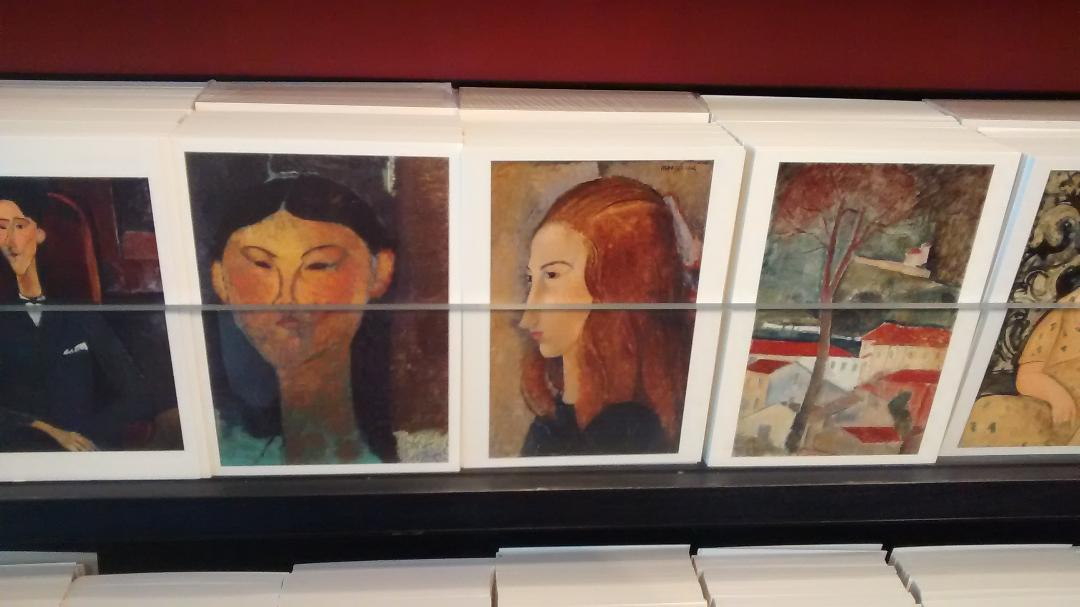
All of which leads to the question that if Modigliani wasn’t really bothered about trying to render the physical likenesses of the various friends and colleagues, lovers and models that he churned out – and for someone who died tragically young and had such a relatively brief career, he does seem to have managed to produce an impressively vast volume of work – what was he actually trying to achieve through his art? And maybe this quandary brings Cezanne back into the picture as he seems to have been similarly obsessed about painting and repainting a comparatively constricted range of subjects. Cezanne, who was somewhat less than gregarious, was perhaps most successful when framing various versions of the landscape around Mount St Victoire or repeatedly rearranging the fruit and veg in his still-life sequences. Modigliani, who seems to have had a very much more outgoing personality, concentrated almost exclusively on people studies and could barely be bothered even to sketch a crude monochrome background once he’d pinned down the silhouette of the body shape and added a few lines to delineate some cartoon facial features. Ultimately, I think that perhaps both artists just retained an almost childlike fascination with trying to fit together shapes and colours into wholly harmonious patterns that somehow carry the universal resonance that puts a smile on the face of all who encounter them. Well, maybe not all – I’m sure there are some grumpy Conceptualists who probably can’t stand either artist – but, personally, I think that I still get the same simple undeniable retinal pleasure when looking at a Modigliani model or a Cezanne apple as I did when I first discovered copies of these things in the art books I happened upon half a century ago.

As careful examination of the brushwork would confirm, the final photo in today’s blog is not, in fact, a rare lost work by Modigliani but a re-engineered copy disinterred from my very own archival vaults. It harks back to a time in Cambridge in the mid-1970s when I enjoyed living la vie Boheme, ingratiating myself among the bright young things of that gilded generation. The painting was a rather crude caricature of a young free-spirited student who subsequently did some life modelling for me before concentrating her skills and intellect on fulfilling her more elevated ambitions in the world of academia, and then becoming everybody’s favourite TV classics don. No, it’s not Bettany Hughes or Natalie Haynes but one-time Oldie pin-up of the year, dear old Mary Beard. Quelle femme – as we used to say in those long-lost days of yesteryear.
