
First of all some exciting technological news: after an extensive research programme into granular meta-data mining techniques and multi-logistical trend monitoring analysis, the special projects team of the marketing and promotions division of the Unvarnished publishing empire have set up an official Unvarnished account with Instagram – hence forward given the official address of unvarnished_official. Following lengthy trial runs, test postings and tweak de-bugging, the soft launch period is now over and, yes, it’s finally official: unvarnished_official is officially on stream providing a daily taster image culled from the previous week’s blog to act as a reminder to see what’s been written about, while also offering a tempting teaser to encourage less literate Instagrammers to up their game and try to start becoming proper grown-up blog-readers. And, since the textual accompaniment to each of the quotidian Instagram pictorial postings is only the briefest of twitter-length paragraph word-bites, hopefully it will appeal to that market segment who are curious about what art attractions are available to see but who shudder at the thought of having to plough through all the interminable pontifical prolixity, heavily laboured humour and grandiloquent neologistic expositions that are such a characteristic part of the Berman blogoriffic prose style, and which divides society into the bifurcated marmiteistical pairings of those who enjoy reveling in absurdly outdated and extravagant Ruskinian verbosity and those who find it an excruciating exercise in self-indulgent waffling of the worst kind.

In either case, those current blog subscribers of a technological bent might wish to link up to the site while the remaining majority could try contacting some youthful relative and asking for their help in explaining what it all means and getting them to set up an account. Then, hopefully, if enough actual humanoid subscribers join together with the current hordes of Russian robot readers and other phalanges of phantom follower, I could even achieve my aim of being recognised as an important internet influencer and start getting invited to some of those warm white wine preview events that form such an important part of the artworld’s social infrastructure.

And just another quick word before moving on to the proper art blogging stuff, to say thanks to all those kind subscribers who expressed concern about the state of the Berman leg and faulty foot attachments which, I’m pleased to say, is a problem that seemed to happily resolve itself without the need of professional medical intervention. Consequently, once again, I’m back pounding my way along the mean streets of the capital city although today’s blog is, in fact, a continuation of the previous journal entry and so carries limpingly on from the clever photo manipulations of Cindy Sherman to the nearby Ben Brown Fine Arts for a display of paintings by Tony Bevan – whose work provides the picturesque interstitial adornment to the previous couple of introductory paragraphs above, and this one below.
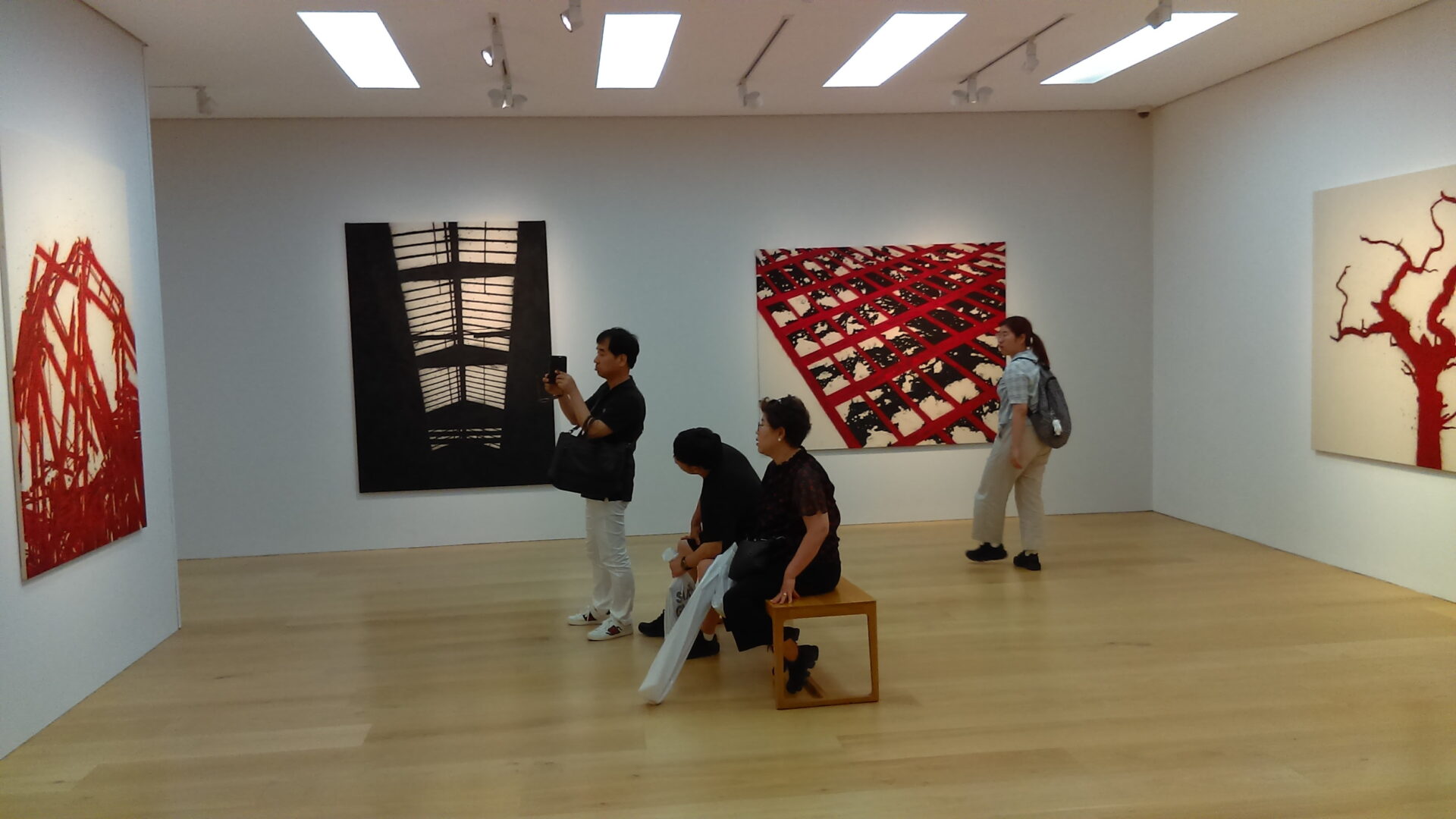
And I think it’s fair to say that Bevan is one of those artists who has carved out a very personal and particular aesthetic styling niche that is a kind of abstractified, simplified form of expressionistic figuration that successfully manages to be weighty without being being portentous. While the subject matter is often rather mundane – grids, skylights, bare shredded trees and the wreckage of semi-demolished building sites – the artist renders it with such obviously studied passion that it attracts the eye and compels the viewer to pause, stare and contemplate, if not the mysteries of the universe, then at least the curious power evoked by detailing simple lines and sharp contrasting colours. As usual, Bevan favours working with a conjunction of red acrylic paint and crusty black charcoal although it’s less the symbolic associations with Anarcho-Syndicalism, AC Milan or Stendhalian literature that he’s interested in than the simple striking tonal and textural interaction generated by this clashing rossoneri combination.

Next stop on the day’s art ride is at the Galerie Thaddaeus Ropac for an interesting historical look back at the work of three female avant gardists from the ‘60s and ‘70s who were experimenting with ideas based around the Minimalist and Conceptualist styles being developed at the time. I can’t say I’m all that endeared with Wanda Czelkowska’s great neo-primitivistic lumps of plaster that are apparently sculpted to resemble head shapes but there’s certainly something wonderfully impractical and impressive about Ellipse, the great loop of thin aluminium paneling that she’s constructed especially to slip round the gallery’s elegant foyer space.

Lydia Okumura’s works are similarly structured on the grand scale using strings to extend the forms of her large carefully crafted geometric wall paintings out into the third dimension of the gallery space interior.

While Rosemarie Castoro offers spindly structures resembling ladders made of charcoal and a spidery parade of magnificently magnified false eyelashes.

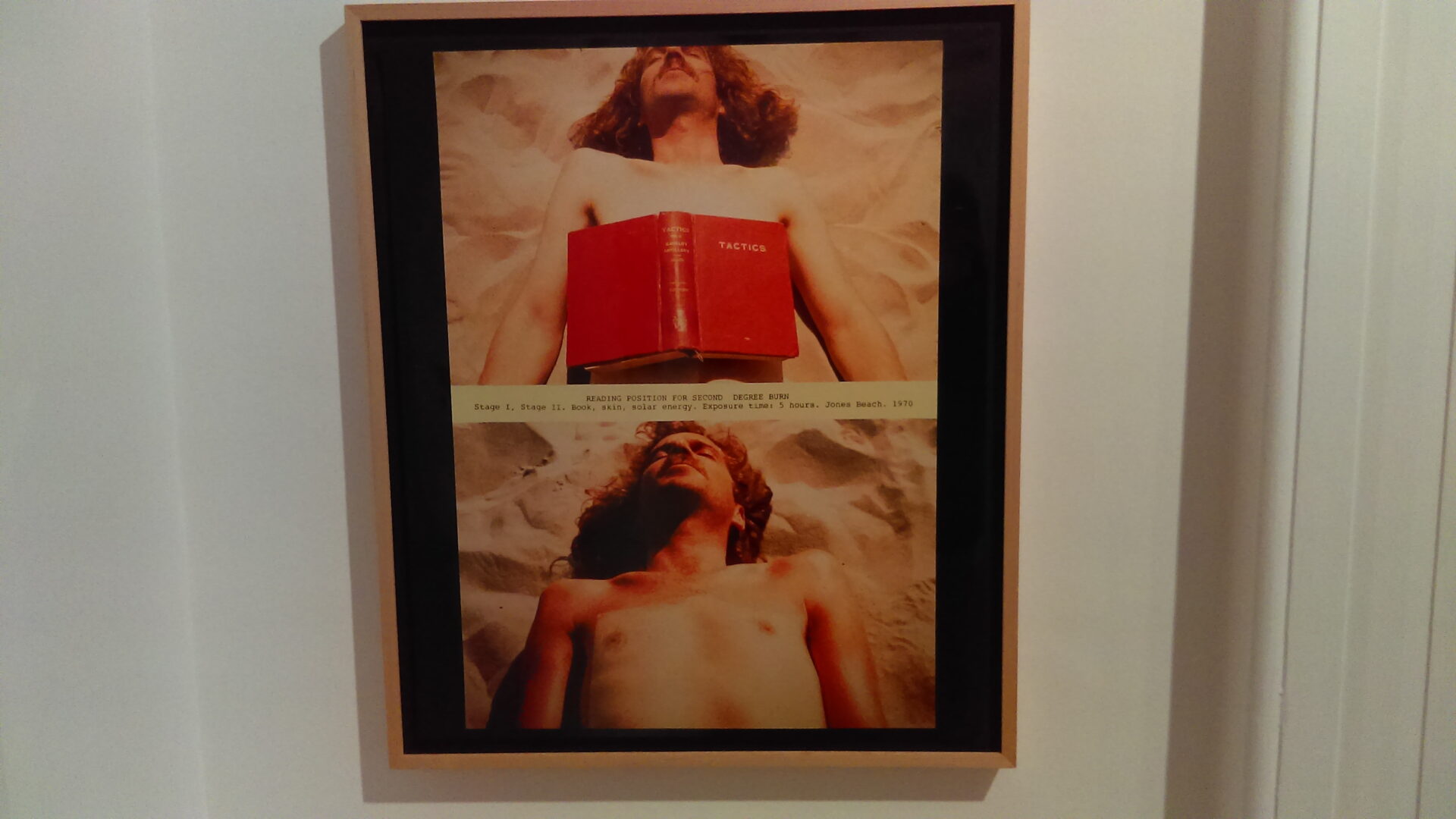
And apologies for the brevity of these descriptions that don’t really do justice to what is a very neatly displayed exhibition that contains a lot of other back-up material, related sketches, models and maquettes and is definitely worth a visit. As is the latest survey show at the Richard Saltoun gallery which focuses on the use of photography during that interesting innovative first phase of Conceptual Art that ran from around 1960 to 1980 and saw an explosion of experimentalism as artists began investigating all sorts of new ideas about what constituted the meaning and making of art. Now, as I think I mentioned the other week when looking at a similar sort of group show at the Simon Lee gallery, some of the stuff produced during this time could definitely be a bit artificially arcane, self-righteously dull or dreadfully pompous but the best of it still throws up odd ideas that are interesting to think about and attractive to look at. And while there’s no poignant Pistoletto dog here today, amongst the interesting photographic curiosities on show are such delights as Keith Arnatt mowing shapes into his garden lawn; John Hilliard refecting on reflections in the glass on a print reproduction of Velazquez’s Rokeby Venus; Ger Van Elk shaping his body tan by hiding under a copy of a book entitled Tactics; Hans Haacke having a political poke at Mobil Oil; and Eleanour Antin parading her collection of 100 rubber boots on a tour around a supermarket, a country home and on to a seaside beach.

I’m not sure whether I’m in concordance with the officially recognised chronologies of art historical evolution, but I tend to think of this first flowering of Conceptualism as the heroic early period in which artists performed and recorded their trials and tribulations, experiments and examinations, wildness and wierdnesses all with a great, straight-faced sobriety. And that all seemed to be foundered upon a set of beliefs based around some kind of shared puritanical Marxist dialectical ways of seeing. After a couple of decades of this, however, a new generation of artists emerged that reworked some of the earlier Conceptualistic ideas into a much flashier, user-friendly form, albeit one that frequently relied on shock tactics to get noticed and generate interest among the non-gallery going general public. But by a rather bizarre ironic twist of fate these new youthful would-be iconoclasts, led by Damian Hirst and followed by the other so-called Young British Artists, having rejected the left-leaning politics of their predecessors, actively seemed to embrace the libertarian wing of the Thatcherite revolution that was causing such contemporaneous societal upheaval at the time. So that, for instance, whereas one of the key areas of concern for the original first generation Conceptualists was how to avoid having their artworks commodified and traded by the hated collectors, dealers and other fascist hyenas of the capitalist establishment, the YBAs were absolutely driven by the desire to mercantalise their art and make as much money out of it as they possibly could. At which point history demands an acknowledgement be made to the spider at the centre of this particular tawdry web: Charles Saatchi, the dealer who designed and promoted the YBAs and whose agency produced the slick adverts that so gleefully helped kill off the hopes and aspirations of the old Labour consensual point of view.
Of course, time has inevitably worked its inexorable magic and the natural forces of entropy have aged the once radical YBAs into the new establishment OBAs leading to the question as to what has happened to the third generation of Conceptualists who might be expected to help contextualise the past couple of decades’ worth of technological invention and social media manipulation. I suppose in keeping with the tradition that art tends to resonate with the politics of the period in which it is made, eventually we can expect the arrival of a new form of Populist Conceptualism which makes me wonder whether twittering President Trump, who seems to be leading the way in these kinds of things, will come to be seen as the 21st Century Marcel Duchamp.

Good to see you back pounding those streets of shame…
Me too – must have been a trial to tramp the streets in pain!
Love these recent shows – Tony Bevan’s work looks really striking. The female artists of the ’60’s and ’70’s look interesting too. I’d like to know how you see them in relation to others working at the time – those in the news probably being mainly men. Any thoughts?
Oh and for got: whose is the work in the final image? Or have I just missed a reference to it?
The final image is one of the shots from Eleanour Antin’s 100 Rubber Boots – sorry it’s not a better shot but if you look carefully you can just make out the eponymous boots lined up on the sea shore.
As for relationship between the three female artists and their mainly male contemporaries, not really enough space to comment in this little box – which I know is a cop out but it really would need a full essay to try to discuss the subject properly. Although, as I hope I indicated, I thought the work (with the exception of the dreadful ‘head’ sculptures) really did look very good in the gallery setting.
Oh yes – I can see that now you explain it! Sometimes it is difficult to know which images you are referring to in the text! Sometimes it is obvious of course, but sometimes it isn’t – especially if the image referred to is not by the relevant bit of text. How about in brackets ‘image above’ or ‘final image’ – just a suggestion!
Yes a suppose the subject of relationships is rather a large one – still maybe you’ll get a chance to write an essay on it sometime. I’ll look forward to it!